
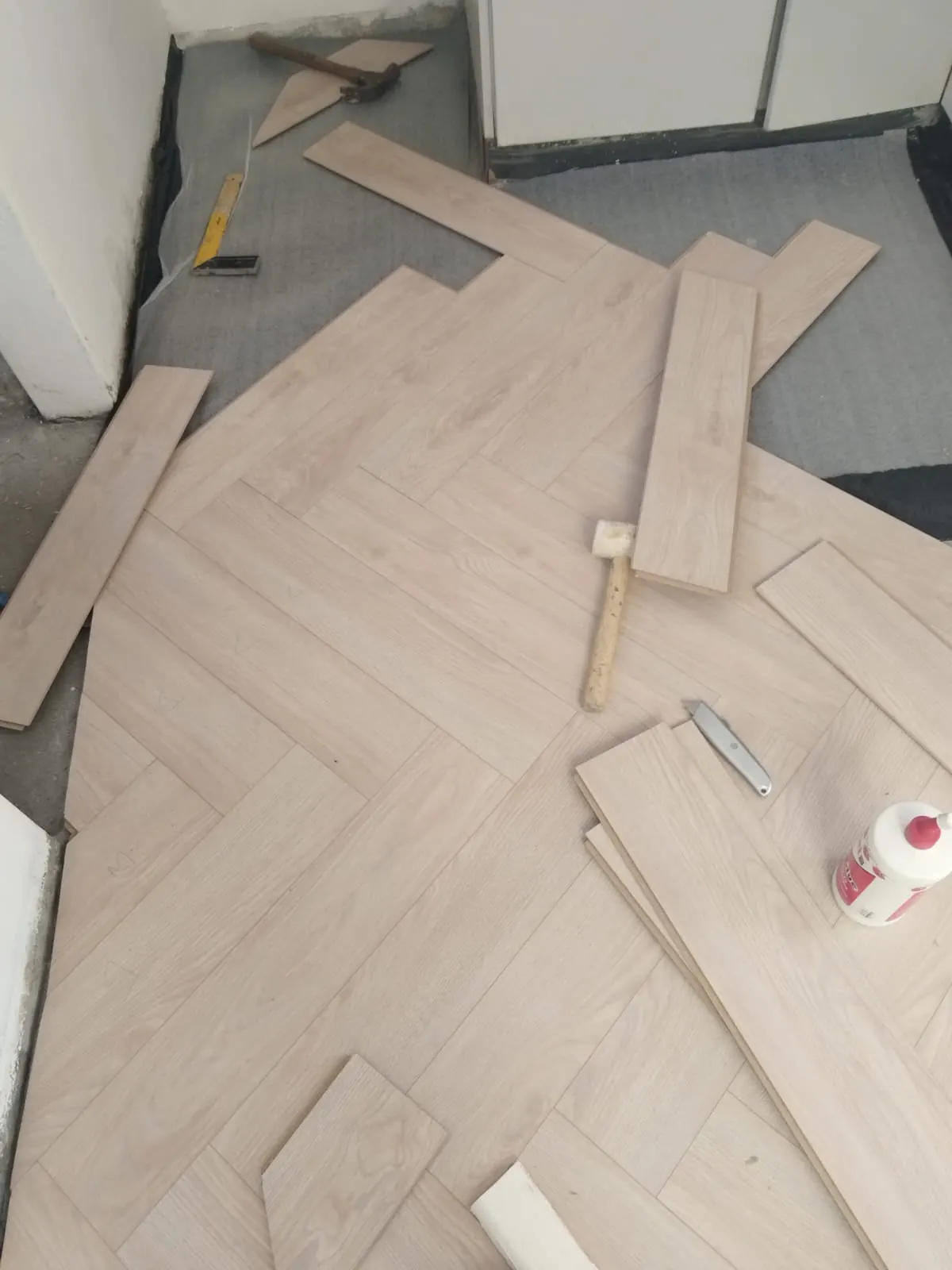
Flooring installation in Cape Town covers four main materials, and they price very differently. This is the overview: what each option costs, where it suits, and which detailed guide to read next.
If you already know the material you want, skip to the relevant section and follow the link. If you are starting from scratch, work through it in order.
The four main flooring installation options
Almost every residential job in Cape Town uses one of these.
- Laminate — printed decor over a fibreboard core. Warm, realistic, not waterproof.
- Vinyl (LVT and SPC) — plastic throughout. Fully waterproof, softer underfoot.
- Engineered wood — real timber veneer on a stable base. The premium option.
- Ceramic and porcelain tile — hardest wearing, coolest underfoot, longest to lay.
What each costs installed
These are supply-and-fit ranges for straightforward residential work in 2026.
- Laminate: roughly R300 to R800 per square metre installed
- Vinyl LVT and SPC: roughly R450 to R800 per square metre installed
- Sheet vinyl: roughly R300 to R500 per square metre installed
- Engineered wood: commonly from R1,300 per square metre installed and upward
- Tiling labour only: roughly R90 to R300 per square metre, tiles extra
Tile is quoted differently to the rest because the tiles themselves vary so widely. Floor tiling labour commonly sits near R110 to R200 per square metre, with wall tiling higher at roughly R140 to R240 because of the extra setting-out and support work. Tile and adhesive standards are published by the South African Bureau of Standards.
For a full breakdown of the vinyl numbers, including the supply-versus-labour split and worked totals, see our vinyl flooring installation cost guide.
Choosing the right material per room
The single most useful question is whether the room will get wet.
- Kitchens, bathrooms, laundries, entrance halls: vinyl or tile
- Bedrooms: laminate or engineered wood, where warmth underfoot matters
- Lounges and dining rooms: any of the four, driven by budget and look
- Rentals and holiday lets: vinyl, because cleaning habits are outside your control
- Outdoor-adjacent rooms with sand traffic: tile or vinyl
Using different materials in different rooms is normal and usually the better answer. Matching tone across a threshold keeps it looking deliberate rather than accidental. We cover this further in our guide to kitchen tiling cape town.
If you are torn between the two most common choices, the laminate vs vinyl flooring comparison settles it on water resistance, feel and lifespan.
Subfloor preparation decides the quality
Every floating floor and every glued floor depends on what sits beneath it. This is the step people cut, and it is the step that causes callbacks. Our guide to large format tiles goes into this properly.
- Basic levelling and patching: commonly R80 to R150 per square metre in labour
- Self-levelling compound: typically R150 to R250 per square metre
- Full screed: a larger job, quoted around R350 to R550 per square metre
An uneven slab under a click-lock floor causes joints to open and planks to rock underfoot. Under glue-down vinyl or wide engineered planks, it shows as visible dips. The material cannot fix the base. If you are weighing that up, our guide to how to choose tiles is worth a read.
Moisture from below
Ground-floor slabs need a moisture barrier. Damp rising through a slab will lift laminate, break the bond under glued vinyl and cup engineered wood. Where there is any doubt, the slab should be checked before anything is laid over it. We cover this further in our guide to re-tiling over tiles.
How long the work takes
Rough timelines for an average room, once the material is on site.
- Click-lock laminate or SPC: often a single day for one or two rooms
- Glue-down vinyl: longer, with curing time before furniture returns
- Engineered wood: plus acclimatisation, typically several days on site first
- Tiling: the slowest, with adhesive and grout curing between stages
- Subfloor levelling: add a day or more, plus drying time
Acclimatisation is not optional on timber products. Boards brought straight from a cold warehouse into a warm room and fitted the same day will move afterwards, and the gaps that open are permanent. For the full picture, see our article on tile removal cost.
Cape Town specifics worth knowing
Coastal conditions change what lasts. Humidity, salt air and strong sun through large windows all shorten the life of the wrong floor, and that is a genuinely local question rather than a general one. The best flooring Cape Town guide covers it in detail.
If real timber is on your shortlist, the engineered wood flooring prices South Africa guide sets out supply, fitting and wear-layer costs.
Getting a quote that holds
Ask for the supply rate and the labour rate as separate lines, with subfloor preparation either priced or explicitly excluded. Confirm whether lifting the old floor, disposal, skirtings and door trimming are included. If you are weighing that up, our guide to vinyl vs laminate cost is worth a read.
We measure on site before quoting, because room shape, cuts and slab condition move the price more than the product does. See our flooring and tiling page for what we cover, or send us your room sizes for a written quote. The assessment is free and there is no call-out fee.
Frequently asked questions
How much does flooring installation cost in South Africa?
Installed rates in 2026 run roughly R300 to R800 per square metre for laminate, R450 to R800 for LVT and SPC vinyl, R300 to R500 for sheet vinyl, and from about R1,300 upward for engineered wood. Tiling is usually quoted as labour only at roughly R90 to R300 per square metre with tiles priced separately. There is more detail in our piece on outdoor tiling cape town.
How long does flooring installation take?
Click-lock laminate or SPC often takes a single day for one or two rooms. Glue-down vinyl takes longer because the adhesive needs curing time before furniture returns. Engineered wood adds several days of acclimatisation on site before fitting starts, and tiling is the slowest of all because adhesive and grout cure between stages. Our guide to reflooring cost cape town goes into this properly.
Can new flooring be laid over existing tiles?
Often yes, provided the tiles are sound, well bonded and reasonably flat. Loose or drummy tiles must come up first because a floating floor over a moving base will fail. Laying over tiles raises the finished floor height, so doors usually need trimming and thresholds need adjusting to suit. There is more detail in our piece on cracked tiles repair.
Do I need to prepare the subfloor before laying a new floor?
Almost always to some degree. Basic levelling and patching typically adds R80 to R150 per square metre in labour, self-levelling compound R150 to R250, and a full screed R350 to R550. An uneven base causes click joints to separate and shows as visible dips under glued floors, and no product can compensate for it. For the full picture, see our article on floor tiling cost.
Which flooring is best for a kitchen or bathroom?
Vinyl or tile. Both are waterproof at the material level, so spills, appliance leaks and wet feet do no permanent harm. Laminate should be avoided in wet rooms because standing water reaching a joint swells the fibreboard core, and swollen boards cannot be repaired, only replaced.