

A bag of skimming plaster 40kg covers roughly 20 to 30 m2 over two coats, or up to 45 to 55 m2 if you are laying a single very thin pass. Retail prices in 2026 sit around R395 to R585 a bag depending on the brand and the merchant.
Those two numbers are all you need to sanity-check a quote or work out what your own room will take. Here is how to use them properly.
Skimming plaster 40kg coverage, realistically
Coverage figures on a bag assume ideal conditions. Real walls are not ideal.
- Single thin coat at 1mm to 1.5mm: roughly 45 to 55 m2 per 40kg bag
- Two coats, the normal specification: roughly 20 to 30 m2 per bag
- At a full 3mm build: around 20 m2 per bag
- Rough or absorbent surfaces: expect the lower end of every range
Two coats is the honest working assumption. Anyone quoting you coverage based on a single 1mm pass is describing a laboratory, not a wall in a fifty-year-old Cape Town house.
Add for waste, every time
- 10 to 15 percent on top of your calculated area for normal waste
- More on rough or patchy surfaces that swallow the first coat
- Material that goes off in the bucket cannot be reused, and it will happen
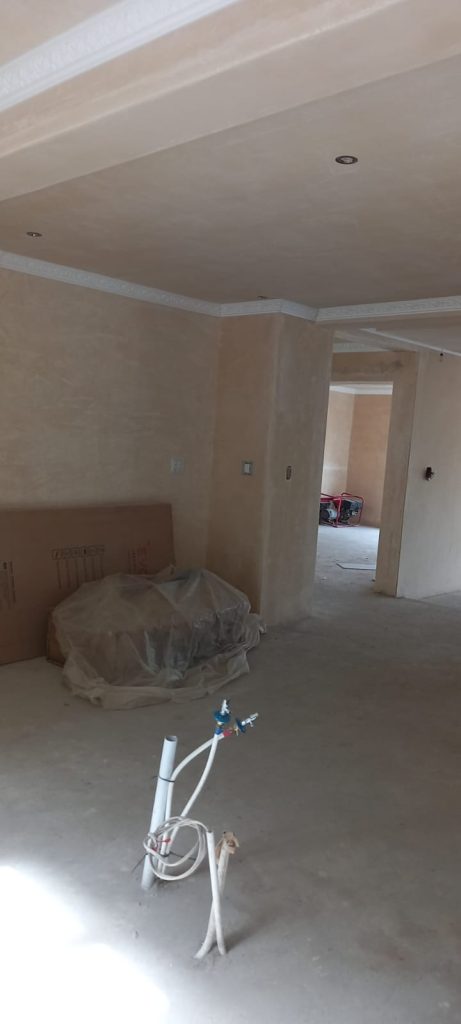
How many bags your room needs
Work out the wall area first, then convert.
- Measure each wall: length times height, in metres.
- Add them up for the total wall area.
- Subtract doors and large windows only if they are significant. A standard door is about 1.8 m2.
- Divide by 25 as a middle-of-the-range two-coat figure.
- Add 10 to 15 percent and round up to whole bags.
A worked example. A 4m by 4m bedroom with 2.7m walls gives about 43 m2 of wall. Take off roughly 4 m2 for a door and window and you have 39 m2. Divide by 25 and you get 1.6 bags. Add waste and round up: two bags.
A larger 5m by 4m lounge at the same height is about 48 m2 of wall, or roughly 44 m2 after openings. That is about two bags plus waste, so three bags to be safe. Add the ceiling and you are at four.
What a bag costs in 2026
Gypsum-based finishing plasters in 40kg bags cluster in a fairly narrow band.
- Typical retail range: roughly R395 to R585 per 40kg bag
- Multipurpose gypsum plasters: commonly around R400 to R460
- Premium or specialist skims: toward the top of the range
- Smaller bags and tubs: far more expensive per kilogram, worth it only for patch repairs
Prices vary by merchant, by region and by how much you buy. Treat these as a planning range, not a quotation, and check current shelf pricing before you budget precisely.
What the material costs you versus what a contractor charges
This is where most homeowners get a surprise, and it is worth understanding before you compare quotes.
- Material only on that 39 m2 bedroom: two bags, so roughly R800 to R1,200
- Labour only for skimming: roughly R40 to R90 per m2, so about R1,600 to R3,500 for the same room
- Supplied and applied by a contractor: roughly R140 to R190 per m2, so about R5,500 to R7,400
The gap is labour, prep, tools, protection, waste and making good. Material is genuinely the small part of a skimming bill, which is why “I will buy the bags myself” saves far less than people expect. Our skimming plaster price guide sets out the full rate structure.
Supplying your own material is usually a false saving
- You carry the waste risk if the job needs more bags than you bought
- Most contractors will not guarantee a finish over material they did not choose
- Wrong product for the substrate is a common and expensive mistake
- Trade pricing often means a contractor buys it cheaper than you do anyway
Getting the product right for your walls
Coverage figures only hold if you have bought the right plaster for the surface. Gypsum-based skims are for internal walls and ceilings. Cement-based skims handle damp-prone and external areas. Board skims are formulated for plasterboard rather than brick. Plaster and skim products are covered by standards published by the South African Bureau of Standards.
Using an internal gypsum plaster in a bathroom or on an exterior wall is one of the most common material errors we see, and it fails within a season. Our explainer on skimming plaster covers which type suits which substrate.
Before you buy anything
Check the wall is worth skimming first. Tap it for hollow areas and look for damp staining. A sound, dry wall takes a skim beautifully. A hollow or damp one will push the new coat straight back off, and you will have spent the money twice.
If you would rather not carry the risk, our skimming team quotes supplied and applied so the coverage maths and the waste are our problem, not yours. Ceilings are priced slightly differently again, as our guide to ceiling skimming explains.
Send us your room dimensions and we will come back with a proper figure. Free assessment, no call-out fee.
Frequently asked questions
How many square metres does a 40kg bag of skimming plaster cover?
Roughly 20 to 30 m2 over two coats, which is the normal specification. A single very thin pass at 1mm to 1.5mm can stretch to 45 to 55 m2, and a full 3mm build brings it down to around 20 m2. Rough or absorbent surfaces always land at the lower end, so plan on two coats.
How much does a 40kg bag of skimming plaster cost?
Around R395 to R585 per 40kg bag in 2026 depending on brand and merchant, with common multipurpose gypsum plasters sitting near R400 to R460. Smaller bags and ready-mixed tubs cost far more per kilogram and only make sense for small patch repairs rather than a whole room.
How many bags of skimming plaster do I need for a room?
Measure the wall area, divide by 25 for a two-coat job, then add 10 to 15 percent for waste and round up. A 4m by 4m bedroom with 2.7m walls works out at about 39 m2 after openings, which is two bags. A larger lounge is typically three, and four if you are doing the ceiling as well.
Is it cheaper to buy skimming plaster yourself?
It saves less than people expect. Material is the small part of the bill: two bags for a bedroom is roughly R800 to R1,200, while supplied and applied work on the same room runs about R5,500 to R7,400 at R140 to R190 per m2. You also carry the waste risk, and most contractors will not guarantee a finish over material they did not select.
What is the difference between skimming plaster and normal plaster?
Skimming plaster is a fine finishing product applied at 2mm to 3mm over a surface that is already sound. Normal sand-and-cement plaster is applied at 10mm to 30mm over bare brick to build the wall surface itself. They are different materials with different coverage, curing times and prices per square metre.