
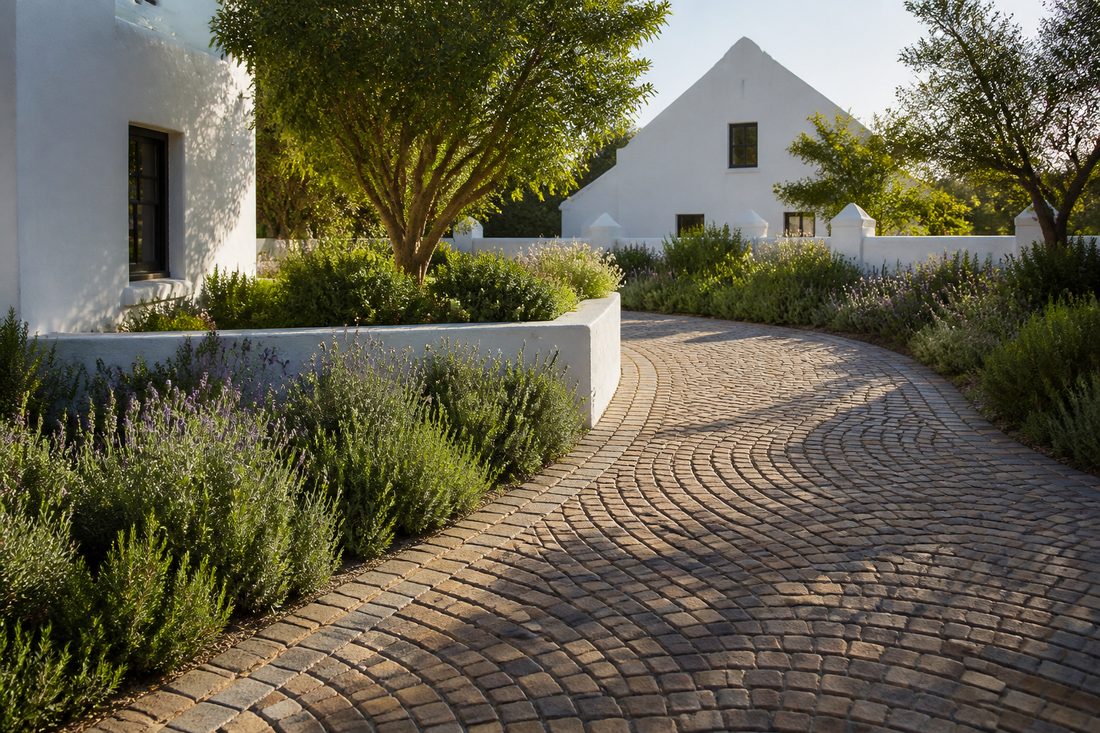
Driveway paving Cape Town homeowners have installed costs roughly R390 to R680 per m² all in for 2026, covering excavation, sub-base, pavers, laying and edging. Concrete sits nearer R330 to R495 per m², brick nearer R385 to R770 per m².
A driveway is not a patio with cars on it. Almost everything about the build changes once a vehicle is involved.
What driveway paving Cape Town jobs actually need
Three specifications separate a driveway from a walkway. Get any of them wrong and the surface ruts within a couple of winters.
- Paver thickness: 60mm is the residential driveway standard. 50mm is for patios and paths. 80mm is for heavy or commercial traffic
- Laying pattern: herringbone at 45 or 90 degrees, because it resists sideways creep under a turning tyre
- Edge restraint: a haunched concrete edge, or the outer rows spread and the field unravels
Large flat slabs do not belong on a driveway at all. The reasoning is set out in our 500×500 concrete pavers price guide, but the short version is that a big slab has no interlock and cracks when a wheel loads one corner.
Sub-base depth for vehicles
This is the part you pay for and never see again.
- Excavate 250 to 300mm below the finished level for passenger vehicles
- Compact the natural subgrade before any material goes down
- Lay 150mm of compacted crushed stone sub-base, built up in two lifts
- Screed 25 to 30mm of bedding sand or crusher dust
- Lay the 60mm pavers, cut the edges, then compact the surface
- Brush jointing sand in and compact again
A patio only needs about 150mm of total excavation. If a contractor quotes the same dig for your driveway as for your patio, they are quoting the wrong job. Paver strength classes and laying guidance come from the Concrete Manufacturers Association.
Drainage and falls
Cape Town winter rain is the real test. Water that cannot escape will find the bed, wash out the bedding layer and drop the pavers.
- Fall away from the house, roughly 1 in 60, never towards a wall
- Keep the finished level below the damp-proof course at the building line
- Add a channel drain where a sloping driveway runs down towards a garage door
- Direct runoff to a bed or soakaway, not onto the pavement or a neighbour
- Consider permeable pavers on a flat site with nowhere obvious to send water
Steep Cape Town properties often need the drainage designed before the paving is. Water coming off a slope arrives faster and in more volume than people expect.
Choosing the paver for a driveway
Material changes the price more than any other decision.
- Concrete interlockers, 60mm: the value option, widest colour range, installed around R330 to R495 per m²
- Clay paving bricks: colour never fades, better with oil and chemicals, installed around R385 to R770 per m²
- Cobbles and cast stone: a feature finish, installed around R495 to R1,100 per m²
- Permeable pavers: a premium over standard concrete, but they solve a drainage problem outright
The full trade-off between the two main materials is in our comparison of brick paving Cape Town against concrete. For most driveways the deciding factor is how long you plan to stay.
Coverage and waste
- 200 x 100mm concrete paver: about 50 per m²
- 220 x 110mm clay paver: about 41 per m²
- Waste for herringbone: 10 to 15 percent, because every edge is a cut
The process from quote to finished driveway
- Site visit and measure, including access for a bakkie and a plate compactor
- Written quote splitting excavation, base, pavers, laying and edging
- Break out and remove the old surface, priced as its own line
- Excavate and compact to the driveway depth
- Base and bedding, screeded and levelled to the falls
- Lay, cut, edge and compact, then joint and compact again
- Clean down and sign off, with the offcuts and spoil taken away
A typical single driveway of 40 to 60m² is a three to five day job when the weather holds. Rain stops base compaction, so winter programmes slip. If you are weighing that up, our guide to paving patterns is worth a read.
Questions worth asking before you sign
- What thickness paver, and is it 60mm?
- How deep is the excavation and how thick is the compacted base?
- Is the edge restraint included?
- Who removes the old surface and the spoil?
- Where does the water go?
If a quote cannot answer those five, it is a number rather than a specification. Our paving quotes list each layer separately so you can compare like with like, and if a boundary wall is part of the same project our boundary wall cost guide covers that side.
Ready for a real number? Send us your driveway measurements and what is on the ground now. The assessment is free and there is no call-out fee.
Frequently asked questions
How much does driveway paving cost in Cape Town?
Roughly R390 to R680 per m² installed in 2026 across materials. Concrete interlockers sit around R330 to R495 per m², clay brick around R385 to R770, and cobbles or cast stone around R495 to R1,100. A 40m² driveway therefore lands somewhere between about R15,600 and R27,200 depending on the paver. Our guide to walkway paving cape town goes into this properly.
How thick should driveway pavers be?
60mm is the standard for a residential driveway carrying passenger vehicles. 50mm pavers are for patios, paths and pedestrian areas only. 80mm is used where there is regular heavy vehicle traffic, such as delivery trucks or commercial yards. There is more detail in our piece on cement paving slabs price.
How deep should the base be for a paved driveway?
Excavate 250 to 300mm below the finished level, compact the natural ground, then lay 150mm of compacted crushed stone sub-base in two lifts, followed by 25 to 30mm of screeded bedding sand. A patio only needs about 150mm of total excavation, so the same dig for both is a warning sign. If you are weighing that up, our guide to concrete paving cape town is worth a read.
What is the best pattern for a driveway?
Herringbone, at either 45 or 90 degrees. Each paver locks against its neighbours at an angle, so the surface resists the sideways creep caused by turning and braking tyres. Stretcher and basketweave patterns are fine for patios but move under vehicle loads. If you are weighing that up, our guide to paving services near me is worth a read.
How long does it take to pave a driveway?
A typical single residential driveway of 40 to 60m² takes about three to five working days: breaking out the old surface, excavating and compacting, base and bedding, then laying, cutting, edging and jointing. Rain stops base compaction, so winter jobs in Cape Town often run longer.