

Stone cladding for exterior walls lives or dies on three things: the wall behind it, the way it is fixed, and how exposed it is. Get those right and it lasts decades. Get them wrong and it fails within a few winters.
Cape Town adds its own pressures. Wind-driven salt on the Atlantic Seaboard, hard UV in summer and sustained driving rain from May to August. This guide covers what actually holds up here.
Is your wall suitable for stone cladding for exterior walls
Start with the substrate. A wall cannot be judged by appearance alone, so it gets checked before anything is priced.
- Bare brick, block or concrete: ideal. Strong, and bonds well after a scratch coat.
- Sound cement plaster: usually fine. Hollow or drummy areas must be cut out first.
- Painted plaster: the paint has to go. Stone must not be bonded onto paint, because the paint can separate from the wall while the adhesive stays attached to the paint.
- Cracked or damp plaster: fix the cause first. Cladding over damp traps it.
- Lightweight partitions and drywall: not suitable for direct bonding. They need a proper backing system.
Weight is a structural question
Stone cladding weighs roughly 55kg to 90kg per square metre depending on thickness. On a solid masonry wall that is not an issue. On a boundary wall built thin, a parapet, or anything already leaning, it is. Have it looked at before ordering stone.
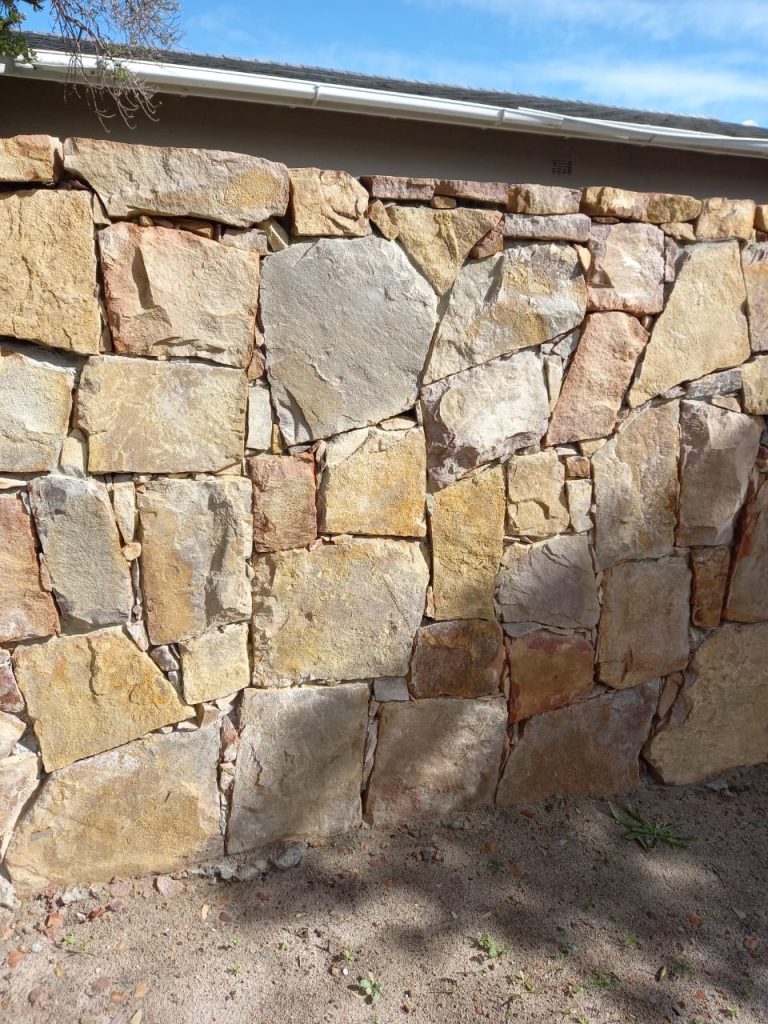
Fixing methods that survive outside
There are two families of fixing, and the difference matters more outdoors than indoors.
- Adhesive-bonded thin cladding. The normal residential method. A polymer-modified adhesive rated for exterior use and for that substrate, over a scratch coat, sometimes with mesh.
- Mechanically anchored panels. Thicker stone hung off anchors on a backing structure, often as a drained and ventilated rainscreen. Used on larger buildings and high elevations.
For a house, adhesive fixing is almost always the answer. What makes it work outside is the detail, not the product.
- Full adhesive coverage behind every piece, with no hollow voids to hold water
- A scratch coat that gives a real mechanical key
- Exterior-rated polymer-modified adhesive, not general tile adhesive
- Corner pieces rather than mitred cuts at external angles
- Movement allowance where the cladding meets a different material
Water has to get out again
Every exterior cladding failure is a water story. The wall gets wet, and the water needs a route out.
- Keep cladding clear of ground level. Stone running into soil or paving wicks moisture upward.
- Detail the top edge. A coping or flashing stops water running in behind the stone.
- Seal around windows and doors where the cladding meets a frame.
- Point properly, or accept that a dry-stack look needs a more careful backing detail.
The base of the wall is where problems show first. Salt bloom or dark staining on the lowest courses usually means moisture is getting in from below, not from the weather.
Cape Town exposure: what changes on a seaward wall
Salt is the difference. Airborne salt settles on the surface and, in porous stone, works its way in. Over years that produces surface loss which sealing slows but does not stop.
- Best on an exposed seaward elevation: dense granite and hard quartzite. Low porosity is what matters.
- Good: quality slate.
- Manageable with discipline: sandstone, if it is sealed properly and re-sealed often.
- Avoid outdoors: marble and travertine.
Fixings matter too. Any metal used in the installation on a coastal elevation should be stainless, not galvanised. Galvanised brackets in salt air rust out long before the stone does.
Sealing schedule by exposure
- Sheltered exterior wall: re-seal every three to five years
- Exposed or coastal wall: every one to two years
- Interior wall: rarely, if ever, after the first seal
Put the first date in your calendar on the day the job finishes. Nobody remembers otherwise, and stone that has gone four years unsealed on a Sea Point facade is already absorbing salt. Cladding and masonry product guidance is published by the Concrete Manufacturers Association.
What exterior stone cladding costs
R900 to R2,500 per square metre installed in 2026, and exterior work sits higher in that band than interior work because of preparation, weather detailing and access.
- Facade band, about 25m2: R22,500 to R62,500
- Full elevation, about 45m2: R40,500 to R112,500 before scaffolding
- Boundary wall, about 30m2: R27,000 to R75,000
Add scaffolding above single-storey reach, roughly 10% wastage, corner pieces per linear metre and the sealer. The drivers behind those numbers are unpacked in our guide to stone cladding prices.
Common exterior mistakes
- Bonding onto paint without stripping it
- Choosing sandstone for a wall that takes direct spray
- Running the cladding straight into the soil
- No coping or flashing at the top edge
- Galvanised rather than stainless fixings near the sea
- Partial adhesive coverage that leaves voids behind the stone
- Never re-sealing
Every one of those is cheap to avoid and expensive to correct, because correcting it means taking the stone off. Before you choose a material, compare the options in our guide to natural stone cladding, or start with the basics in our stone cladding guide.
Booking an assessment
We check the substrate, test whether the plaster is sound, look at the exposure of that specific elevation and tell you which stones are sensible on it. The assessment is free and there is no call-out fee.
See our stonework services page, or send us photos of the elevation for a written quote.
Frequently asked questions
Is stone cladding suitable for exterior walls?
Yes, provided the substrate is sound and the detailing is right. The wall must be strong enough to carry roughly 55kg to 90kg per square metre, the surface must bond properly, and water needs a route out at the top edge and the base. Exterior-rated polymer-modified adhesive is essential, not general tile adhesive.
Can stone cladding be applied directly to plaster?
To sound, unpainted cement plaster, usually yes, though it is normally keyed or given a scratch coat first. Any hollow or drummy areas must be cut out and made good. If the plaster is painted, the paint has to be stripped or mechanically prepared back to a sound mineral surface before anything is bonded to it.
What is the best stone cladding for coastal areas?
Dense, low-porosity stone. Hard quartzite and granite resist salt and UV best, and quality slate performs well too. Porous stones such as sandstone and travertine absorb airborne salt and suffer gradual surface loss. On a coastal wall, also specify stainless rather than galvanised fixings, since galvanised metal corrodes quickly in salt air.
How often should exterior stone cladding be sealed?
Every three to five years on a sheltered exterior wall. On an exposed or coastal elevation taking direct salt spray, every one to two years. Sealing reduces moisture and salt penetration rather than eliminating it, so the schedule matters more than the product. Interior walls rarely need resealing after the initial application.
Why does exterior stone cladding fail?
Almost always water or bonding. Common causes are bonding onto paint, partial adhesive coverage that leaves voids, cladding running straight into soil so moisture wicks upward, and no coping or flashing at the top edge letting water in behind the stone. Choosing a porous stone for an exposed wall is the other frequent cause.