

Stone cladding is a thin skin of stone fixed to a wall built from something else. It gives you the look of solid stonework without the weight, the depth or the cost of building in stone.
This guide covers what it actually is, where it works in a house, how it gets fixed on, what it costs and how to look after it. It is written for homeowners, not builders.
What stone cladding is
Take a brick or block wall. Bond a layer of stone onto the face of it. That is cladding. The wall behind still does all the structural work.
The stone is usually 20mm to 40mm thick. Suppliers commonly sell two formats.
- Strip walling, roughly 20mm to 30mm high, for a fine coursed look
- Building stone, roughly 40mm to 60mm, chunkier and more rustic
Both come in a natural form with an irregular back, and a cut form with a straight sawn back that sits flatter against a wall. The cut form is easier to fit and usually costs more.
Natural stone versus simulated stone
- Natural stone is quarried. Every piece differs in colour, size and depth. It weathers well and lasts decades.
- Simulated or cement cladding is cast in moulds to look like stone. It is lighter, more uniform and cheaper, and the pattern repeats if you look for it.
Neither is wrong. Simulated cladding is a sensible choice on a lightweight wall or a tight budget. Natural stone wins on a feature wall you will look at every day.
Where stone cladding is used
Indoors and outdoors, but for different reasons.
- Entrance walls and pillars to give a facade some weight
- Braai areas and fireplace surrounds, the single most common job
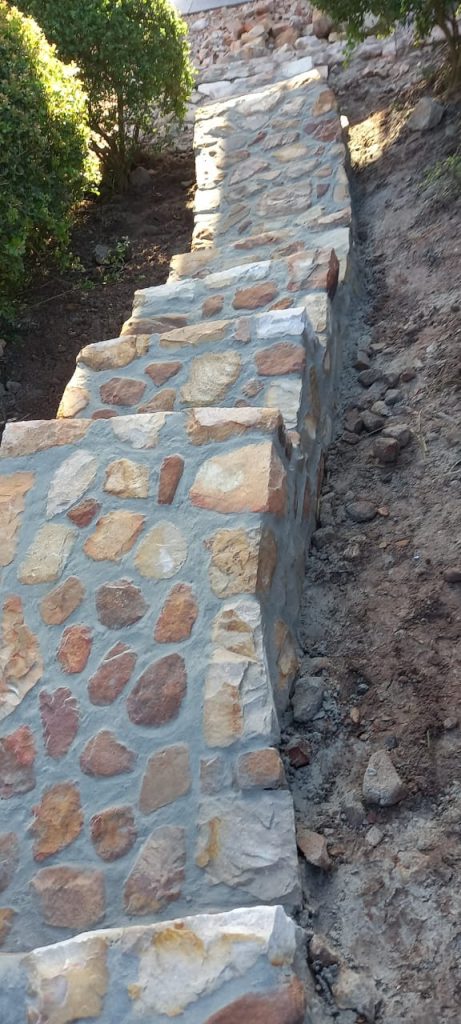
- Boundary and garden walls, especially where plaster keeps cracking
- Pool surrounds and water features
- Interior feature walls in a lounge or stairwell
- Facade bands on part of an exterior elevation rather than the whole thing
One planning note. Cladding an entire house rarely looks better than cladding one section of it. Used everywhere, the texture stops reading as a feature.
How stone cladding is fixed to a wall
For the thin adhesive-fixed cladding used on most homes, the sequence runs like this.
- Check the substrate. It must be sound, stable and strong enough to carry the weight.
- Prepare the surface. Key smooth plaster, strip paint, repair cracks.
- Apply a scratch coat where needed, sometimes over mesh, to give the adhesive a proper bond.
- Set out the pattern and dry-lay a section so the colours mix evenly.
- Bond the stone with a polymer-modified adhesive rated for the substrate and for exterior use.
- Work the corners using corner pieces so no cut edge shows.
- Point or dry-stack, depending on the look.
- Clean and seal.
Substrate is where most failures start. Stone should not be bonded directly onto paint, because paint can separate from the wall while the adhesive stays stuck to the paint. Heavier stone on a tall wall may need mechanical anchoring rather than adhesive alone.
The colour-mixing trick
Natural stone varies between pallets. Draw stones from every pallet as you work rather than emptying one at a time, or you get visible bands of colour across the finished wall. It costs nothing and it is the difference between a good wall and an obviously patchy one.
What stone cladding costs
Installed, R900 to R2,500 per square metre in 2026, with some South African guides quoting up to R2,750. Supply-only stone starts from around R200 per square metre on promotion and runs past R1,400 for premium quartzite. Cladding and masonry product guidance is published by the Concrete Manufacturers Association.
- Braai surround, about 4m2: R3,600 to R10,000
- Feature wall, about 10m2: R9,000 to R25,000
- Facade band, about 25m2: R22,500 to R62,500
Budget separately for corner pieces, roughly 10% wastage, surface preparation and sealer. The full breakdown of what moves the rate is in our guide to stone cladding prices.
Maintaining it
Properly installed stone cladding lasts a long time. Lifespans of 30 to 50 years and beyond are normal, and it often outlives the wall it is fixed to. The upkeep is light but not zero.
- Rinse it down with water and a soft brush once or twice a year
- Re-seal exterior walls every three to five years, or every one to two years in heavy salt spray
- Never use acid cleaners on limestone, sandstone or travertine
- Keep a low-pressure washer well back, or use none at all on pointed work
- Repoint small failures early before water gets behind the veneer
Watch the base of the wall. Rising damp shows up as staining or salt bloom on the lowest courses, and it needs the damp fixed rather than the stone cleaned.
Deciding whether stone cladding is right for your wall
Ask three questions before you commit.
- Is the wall sound, and is it strong enough to carry 55kg to 90kg per square metre?
- Is this an exposed elevation, and if so, which stones will actually survive there?
- Is this a feature, or are you about to clad everything?
The stone choice deserves real thought, and the differences between sandstone, slate, quartzite and granite are covered in our guide to natural stone cladding. If the wall faces the sea, read the notes on stone cladding for exterior walls first.
We assess the wall, tell you honestly whether cladding is the right answer, and quote the stone and the labour separately. Free assessment, no call-out fee.
See our stonework services, or send us a photo of the wall for a written quote.
Frequently asked questions
What is stone cladding used for?
It is a decorative and protective layer of stone applied to a wall built from something else, usually brick or block. Homeowners use it on entrance walls, braai and fireplace surrounds, boundary walls, pool areas and interior feature walls. It gives the appearance of solid masonry without the weight, depth or cost of building in stone.
How thick is stone cladding?
Typically 20mm to 40mm for the thin cladding used on homes. South African suppliers commonly sell strip walling at around 20mm to 30mm and building stone at around 40mm to 60mm. Thicker mechanically anchored panels are used on larger buildings, but they need a proper support system rather than adhesive.
How is stone cladding attached to a wall?
Most residential cladding is bonded with a polymer-modified adhesive over a prepared substrate, often on a scratch coat and sometimes over mesh. The wall must be sound, clean and strong enough to carry the weight. Heavier stone or tall exterior walls may need mechanical anchoring rather than relying on adhesive alone.
Can stone cladding be installed on a painted wall?
Not directly. Paint is not a dependable bonding surface, and it can separate from the wall even when the adhesive is still firmly attached to the paint. The paint should be stripped or mechanically prepared back to a sound mineral background first. A lightly scratched patch is not enough if the rest of the paint stays on.
How long does stone cladding last?
Installed correctly and maintained, typically 30 to 50 years or more, and natural stone often outlasts the wall it is fixed to. Lifespan depends on the stone chosen, the quality of the substrate preparation and whether it is re-sealed. Exterior walls generally need re-sealing every three to five years.