
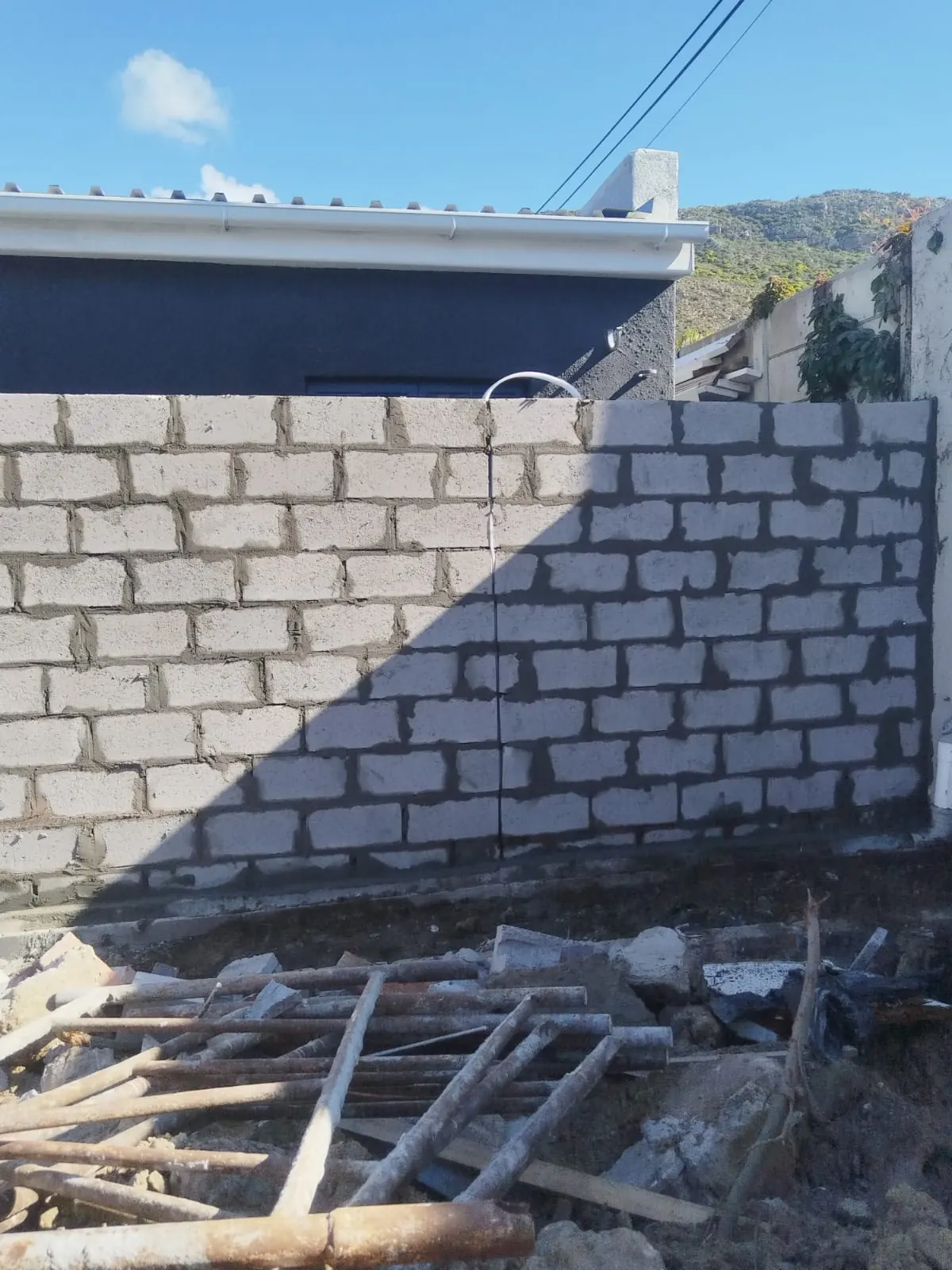
A vibracrete wall costs R620 to R1,400 per metre installed in Cape Town in 2026. Most standard 1.8m boundary walls land near the bottom of that band. Security-height walls sit at the top.
Cape Town calls it vibracrete. The rest of the country usually says precast. It is the same product: reinforced concrete panels that slot into grooved concrete posts, set into a footing.
What a vibracrete wall actually is
Panels are roughly 1,400mm wide and about 300mm high each. They stack between posts, so wall height is set by how many panels you stack.
- Panels — plain, louvre or a moulded pattern face
- Posts — usually 100mm square, thicker on heavy-duty specs
- Footing — a concrete foundation under each post
- Coping or topper — optional finishing or security top
People also call it a “stop nonsense wall”, which is Cape slang for the plain concrete boundary wall you see on most side and rear boundaries in the northern and southern suburbs.
Vibracrete wall prices per metre in 2026
Height is the single biggest price driver. Published Cape Town planning ranges for installed walling look like this.
- 1.8m standard: about R620 to R820 per metre
- 2.1m standard: about R690 to R920 per metre
- 2.4m standard: about R735 to R998 per metre
- 2.4m to 2.7m heavy duty: about R1,300 to R1,400 per metre
By panel style, Western Cape supply-and-install lists put plain panels at R650 to R760 per metre and louvre panels at the same R650 to R760 per metre. Crushed-clay and stone-look faces run R820 to R998 per metre.
A useful rule installers use locally: every extra 300mm of height adds roughly R150 to R200 per metre.
Why quotes for the same wall differ so much
Sources disagree because “precast walling” is not one product. Two quotes can both be honest and still be R300 a metre apart.
- Whether the old wall or fence is being demolished and carted away
- Ground conditions — sand is quick, rock and clay are not
- Sloping boundaries that have to be stepped panel by panel
- Access down a narrow side passage, which means carrying every panel
- Gates, spikes or electric fencing added to the total
Ask every contractor to price the same scope. Otherwise you are comparing numbers that describe different jobs.
Supply only versus supply and install
You will see plain 1.43m slabs advertised around R80 to R90 each at hardware retailers. That looks far cheaper than a per-metre installed rate, and it is not a fair comparison.
An installed price includes posts, correct post spacing, excavation, concrete footings, levelling, labour and transport. DIY slab pricing includes none of that. Buying slabs only makes sense if you are building it yourself and already own the tools.
Vibracrete or a brick boundary wall
Concrete panels are the cheaper option in almost every case. A plastered brick boundary wall is generally quoted at R1,200 to R1,800 per metre, and face brick at R1,800 to R2,500 per metre. Contractor-built single-skin plastered walls at 1.8m are quoted as high as R2,800 per metre once footings, piers and coping are included. Mix ratios and workmanship standards are published by the South African Bureau of Standards.
The trade-offs are simple. Precast goes up in days and costs less. Brick lasts longer, looks better from the street and can be plastered or painted to match the house. Our brickwork and plastering team builds both, so ask for a comparison on your actual boundary rather than a general rule.
Common upgrades
- Raising an existing wall — adding one or two panels for privacy or electric fence height
- Plastering the panels — turns a plain wall into a smooth painted surface
- Louvre panels — airflow and filtered light, useful on windy Cape plots
- Pattern faces — better street presence on a front boundary
Plastering a precast wall is popular and works well, but the surface has to be prepared properly or the plaster cracks along the panel joints. That is the same skill set as replastering walls on a house, and it is worth using someone who does it every week.
How installation works
- Site visit and measure — the boundary length, slope and access are checked
- Set out — post positions are marked at fixed centres
- Excavate and cast footings — posts are set plumb and left to cure
- Slot in panels — panels drop into the post grooves from the bottom up
- Step and finish — slopes are stepped, joints pointed, site cleaned
Most residential runs take two to three days. Rock, heavy slope or a demolition of the old wall adds a day or more.
Before you sign anything
Check the boundary line first. Under the Fencing Act, the cost of a wall on a shared boundary is normally a joint responsibility between both owners, so speak to your neighbour before you order. Also check your title deed and any estate or body corporate rules on height and finish.
We give a free on-site assessment and there is no call-out fee. Send us your boundary length and we will price the wall properly. If you are still choosing who to use, read our guide to building contractors cape town homeowners can rely on.
Frequently asked questions
How much does a vibracrete wall cost per metre in Cape Town?
Around R620 to R1,400 per metre installed in 2026. A standard 1.8m wall usually sits at R620 to R820 per metre, 2.1m at R690 to R920 and 2.4m at R735 to R998. Heavy-duty security walls between 2.4m and 2.7m run R1,300 to R1,400 per metre. Height, ground conditions and access decide where you land.
Is vibracrete the same as precast walling?
Yes. Vibracrete is a brand name that Capetonians use as a general term for precast concrete boundary panels. The product is the same: sand, cement and stone aggregate cast into reinforced panels that slot into grooved posts. If a supplier quotes precast and another quotes vibracrete, you are comparing the same thing.
Why is a 2.4m wall so much more expensive than a 1.8m wall?
A taller wall needs more panels, longer posts and usually a deeper footing, because wind loading increases with height. Handling and alignment also take longer. Locally, installers reckon on roughly R150 to R200 extra per metre for every additional 300mm of wall height.
Can I add electric fencing or spikes on top of a precast wall?
Yes, and it is one of the most common upgrades. Many owners raise an existing wall by one or two panels first so the topper reaches the height their insurer or security company wants. The wall must be structurally sound before anything is fixed to the top, so have the posts and footings checked.
What is the biggest hidden cost with vibracrete walling?
Ground conditions and slopes. Sand is quick to dig, rock and clay are not, and a sloping boundary has to be stepped panel by panel, which adds labour. Demolishing and removing an old wall or fence, including breaking out old footings, is the other item people forget to budget for.