
Timber decking Cape Town homeowners install costs roughly R1,000 to R1,270 per m² for pine and R1,270 to R2,000 per m² for balau, installed. Premium hardwood builds from specialist deck companies are quoted higher, often R1,700 to R3,500 per m².
The wood you choose decides the price, and the Cape’s coastal weather decides how long it lasts.
Timber decking Cape Town prices per m²
These are installed figures, meaning substructure, boards, fixings and labour.
- Pine (pressure-treated): R1,000 to R1,270 per m²
- Balau: R1,270 to R2,000 per m²
- Premium hardwood specialist builds: R1,700 to R3,500 per m²
- Composite: R1,650 to R3,850 per m² installed, with some sources quoting up to R4,500
Where sources disagree, the difference is almost always substructure. A deck sitting on a flat concrete slab is cheap. A raised deck on steel or treated posts over a slope is not.
What pushes the price up
- Height off the ground. Raised decks need more framing and often balustrades.
- Slope. Uneven ground means more posts and more levelling.
- Shape. Curves, steps and pool surrounds mean more cuts and more waste.
- Board width. Narrower boards mean more boards and more fixings per m².
- Fixings. Hidden clip systems cost more than face-screwing but look far better.
- Access. Carrying hardwood through a house is slow, and slow is money.
Which timber suits Cape Town’s coast
Salt air, hard UV and wet winters are a demanding combination. Timber choice matters more here than inland.
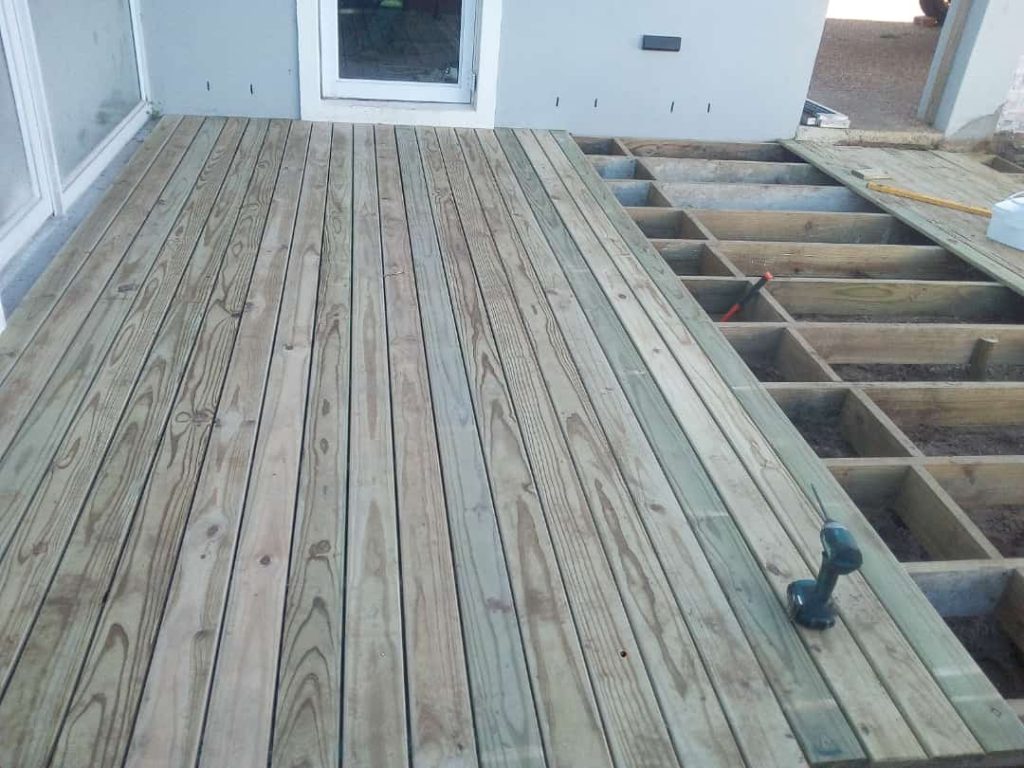
- Pressure-treated pine: the budget option. Softer, dents more easily, and needs regular treatment. Good value for covered or low-traffic decks.
- Balau: a dense tropical hardwood with high natural oil content. Holds its shape well in damp and high-traffic areas, which is why it dominates Cape Town pool decks.
- Garapa: lighter in colour, stable, popular where a paler finish is wanted.
- Massaranduba and ipe: very dense, very durable, priced accordingly.
Denser timber costs more per m² but resists cupping, splintering and insect attack better. On an exposed Atlantic Seaboard or False Bay deck, that difference shows within a few seasons.
Maintenance: what a Cape deck actually needs
Every timber deck greys and dries out if left alone. Oiling is what keeps colour and slows cracking.
- Coastal decks: re-oil every 6 to 8 months
- High-UV inland decks: every 8 to 12 months
- Covered or shaded decks: around every 12 months
The routine is simple: clean, let it dry fully, sand any rough patches, then oil in warm dry weather with no rain forecast for a day or two.
Signs your deck is overdue
- Water soaks in instead of beading on the surface
- The colour has gone silver-grey
- Boards feel rough or splinter underfoot
- Fine surface cracking along the grain
- Green or black staining in permanently shaded sections
Composite versus timber decking
Composite boards mix wood fibre and polymer. They do not need oiling, and that is their whole argument.
- Cost: higher upfront at R1,650 to R3,850 per m² installed
- Maintenance: washing rather than sanding and oiling
- Heat: darker composite gets noticeably hot in direct Cape summer sun
- Look: uniform and consistent, which some people like and others do not
- Repairs: a damaged composite board is replaced, not sanded out
If you would genuinely rather not oil a deck twice a year, composite is worth the premium. If you like the look and feel of real hardwood, balau at R1,270 to R2,000 per m² is hard to beat.
Design choices that change the final bill
Two decks of identical size can price very differently. These are the choices that move the number most.
- Rectangles are cheapest. Every curve or angled corner adds cuts, waste and time.
- Steps are expensive per metre. They need their own framing and stringers.
- Balustrades add up fast. They are priced per linear metre, separate from the deck area.
- Board direction matters. Running boards diagonally looks good and increases waste.
- Built-in benches and planters are carpentry projects in their own right.
Decide these before you ask for quotes. Changing the design halfway through is where budgets break, the same way it does on fitted joinery — a pattern we cover in our built in bedroom cupboards designs guide.
Getting a deck quote that holds
Ask for the substructure to be specified, not just the boards. That is where quotes quietly differ, and where a cheap deck starts to move underfoot after two winters.
Also confirm the fixing method, the joist spacing, and whether the quote includes steps, balustrades and finishing oil. Those four items alone can swing a price by thousands. Board and timber product standards are published by the South African Bureau of Standards.
Our approach to fitted timber work is the same one we apply to decks, and you can see how we itemise it in our built-in cupboards cape town pricing guide.
We offer a free on-site assessment with no call-out fee. See our carpentry services, or send us your deck measurements for an itemised quote.
Frequently asked questions
How much does timber decking cost per square metre in Cape Town?
Pine decking runs about R1,000 to R1,270 per m² installed and balau about R1,270 to R2,000 per m². Specialist hardwood deck builders in Cape Town quote R1,700 to R3,500 per m² for premium timbers and raised structures. Substructure complexity is the biggest single variable.
Which is the best wood for decking in South Africa?
Balau is the most common choice for South African decks because it is dense, high in natural oils and stable in damp, high-traffic areas like pool surrounds. Garapa, massaranduba and ipe are also used. Pressure-treated pine is the budget option but is softer and needs more frequent treatment.
How often should you oil a deck in South Africa?
Most decks need oiling every 6 to 12 months. Coastal decks exposed to salt air need it every 6 to 8 months, high-UV inland decks every 8 to 12 months, and covered or shaded decks around every 12 months. Oil in warm dry weather with no rain forecast for 24 to 48 hours.
Is composite decking cheaper than wood?
No, composite costs more upfront at roughly R1,650 to R3,850 per m² installed, against R1,000 to R2,000 per m² for pine or balau. It saves on maintenance because it does not need sanding and oiling. Darker composite boards also get hot in direct summer sun.
How long does a timber deck last in Cape Town?
It depends on timber and upkeep. Pressure-treated pine typically gives a shorter service life and needs regular treatment, while dense hardwoods like balau last considerably longer. Coastal salt air and UV shorten the cycle either way, so a deck that is cleaned and re-oiled on schedule will always outlast one that is not.