
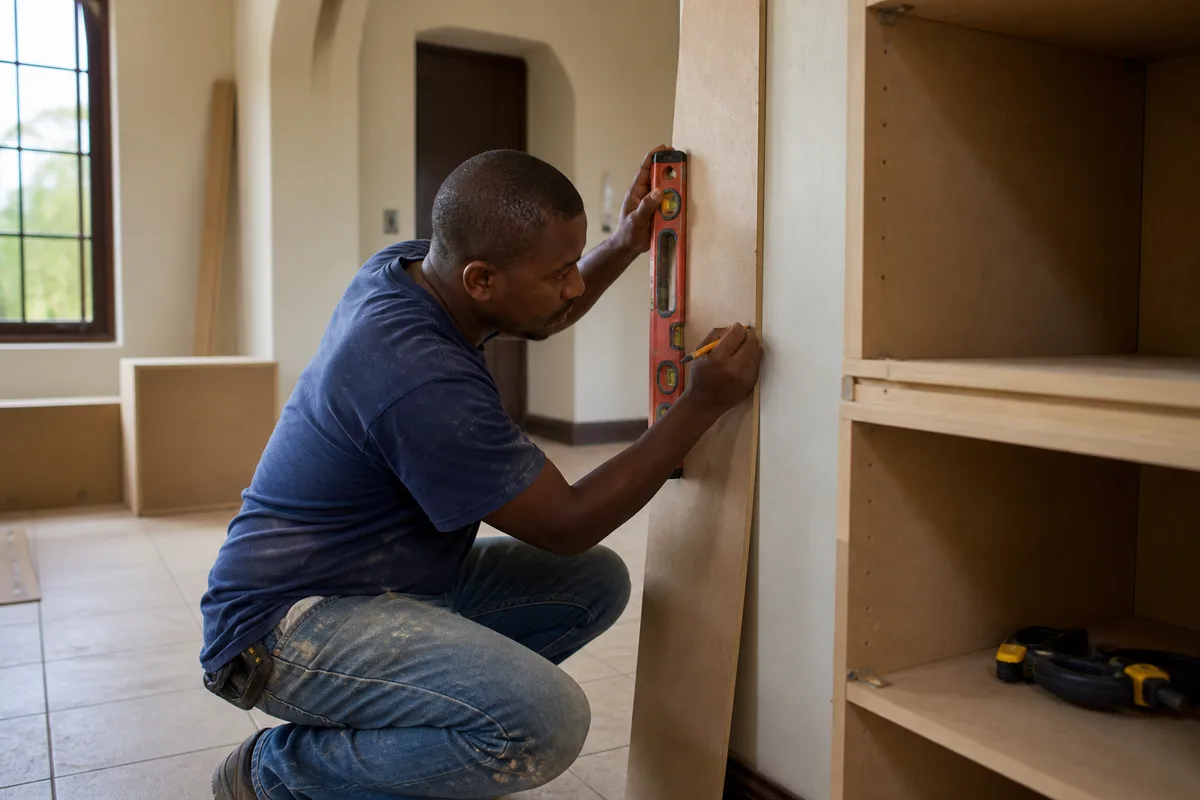
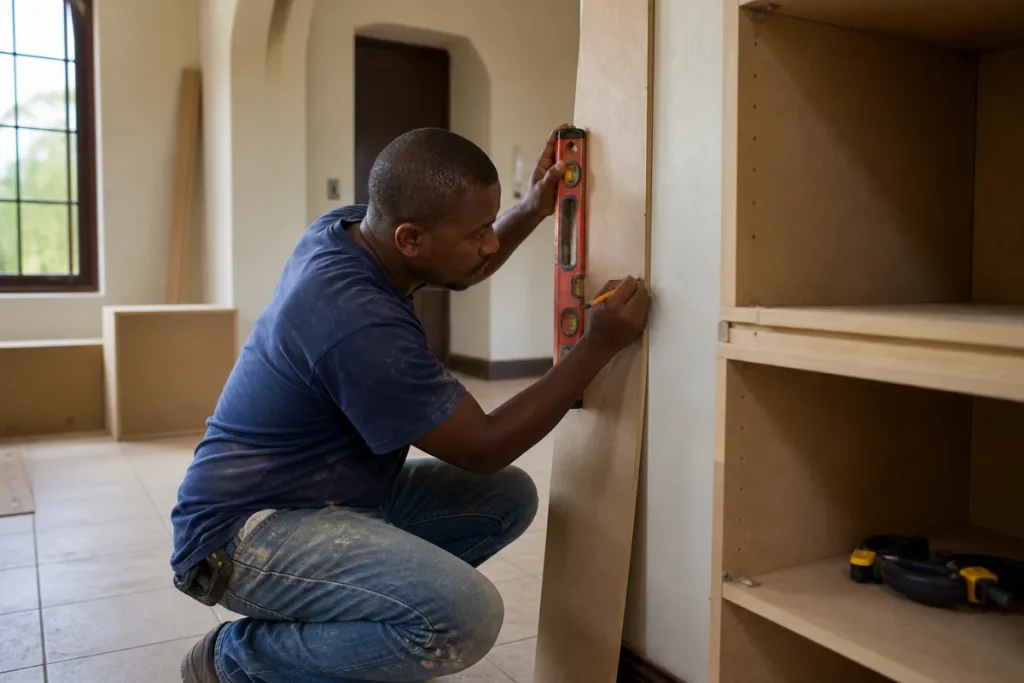
Built in cupboards Cape Town homeowners order in 2026 cost between R4,400 and R13,200 per linear metre installed, with premium finishes reaching R22,000. Kitchen units sit higher than bedroom units because of appliance cut-outs, plumbing and countertop work.
This guide covers what you get at each price level, what the coast does to board, and the questions that stop a quote turning into a surprise.
Built in cupboards Cape Town price levels
All fitted cupboard work is priced per linear metre of wall. Measure your wall and you can check any quote yourself.
- Bedroom, basic melamine: R4,400 to R8,000 per metre
- Bedroom, mid-range: R8,000 to R13,200 per metre
- Bedroom, premium veneer or sprayed: R13,200 to R22,000 per metre
- Kitchen units: R5,500 to R20,000 per metre depending on finish and complexity
Installers charging by the hour sit around R350 to R600. That model only makes sense for repairs and alterations. For a new unit, insist on a per-metre or per-job price so the risk sits with the person who can control it.
Why kitchen cupboards cost more
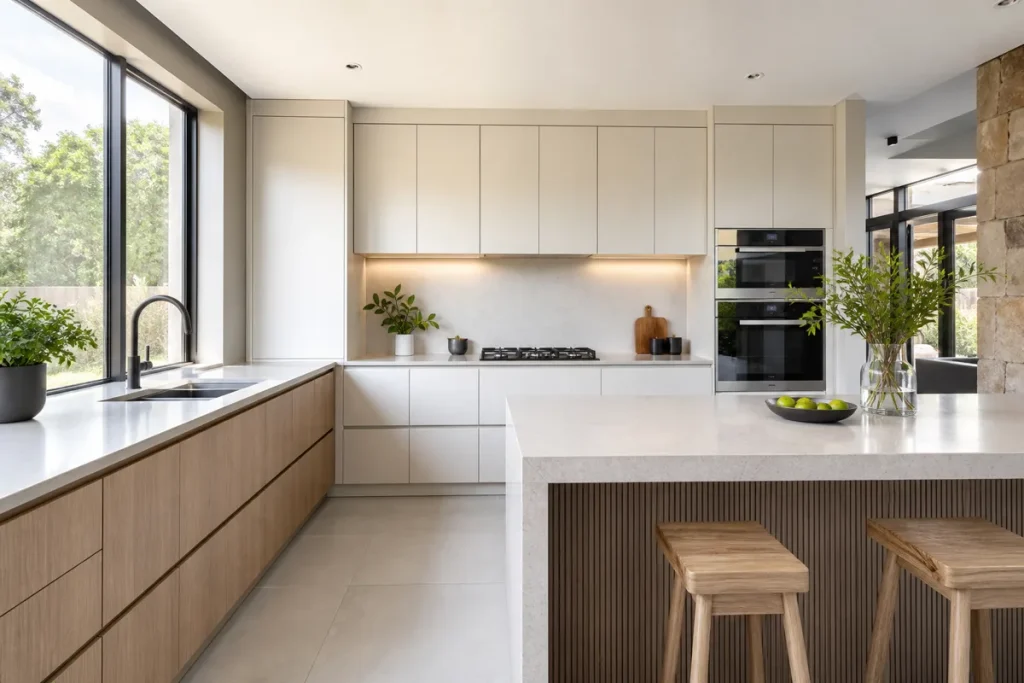
A kitchen carries work a bedroom does not: cut-outs for hob, oven and sink, service routing for plumbing and power, and a countertop that has to meet the units exactly. More trades on one job means more coordination and more cost.
Coastal conditions and custom cupboards in Cape Town
Cape Town’s salt air and winter damp are hard on board. Two things are worth specifying, especially in Sea Point, Table View, Blouberg and the southern coastal suburbs. Board and timber product standards are published by the South African Bureau of Standards.
- Moisture-resistant board where units meet a floor that gets mopped, or an outside wall
- Sealed and edged panels on all sides, not just the visible faces, so moisture cannot get into the core
Unsealed chipboard edges swell. Once a base panel has lifted it cannot be repaired, only replaced. If a wall behind the units has a damp history, deal with that first — a waterproofing problem hidden behind new cupboards will ruin them within a couple of winters.
What to check before signing a cupboard quote
- Is the price per linear metre or for the whole job, and is fitting included?
- Which board is being used, and is it moisture resistant?
- Are all panel edges sealed, including the hidden ones?
- Are hinges and runners soft-close, and what brand?
- Does the price cover removing and disposing of the old units?
- Is making good the wall afterwards included?
- Is painting included, or a separate trade?
- What guarantee covers the carcass and the hardware?
Points five and six are the usual gap. Ripping out old cupboards damages plaster almost every time. If nobody has priced the repair, that lands on you at the worst moment — with the new units waiting to go in.
Custom cupboards or off-the-shelf?
Off-the-shelf is cheaper per metre and faster. Custom costs more and fits properly. The deciding factor is usually the room itself.
Older Cape Town houses rarely have square walls or level floors. A modular unit against an out-of-square wall leaves a tapering gap that no amount of trim hides neatly. Custom units are scribed to the actual wall, so the join is clean. Our guide to built-in cupboards designs for small bedrooms goes into this properly.
Custom also wins wherever the space is unusual — under a staircase, into a sloped roof, around a chimney breast, or in a room where you want the full wall height used rather than losing the top 400mm. For the full picture, see our article on built in cupboards bedroom south africa.
Planning the job around your other work
Sequence matters. Get these in the right order and you pay once instead of twice.
- Wall repairs and smoothing first. Any skimming should happen before units go in, while the wall is still accessible.
- Electrical moves next. Plug points that will end up behind a cupboard need relocating before, not after.
- Painting the room second-to-last, so you are not cutting in around a fitted unit.
- Cupboards last.
Small repairs and adjustments around a cupboard installation — a sticking door, a shelf that needs re-hanging — are usually a handyman near me job rather than a carpentry one, and cost far less booked that way.
See the full scope on our carpentry services page, or send your wall measurements and we will quote in writing.
Frequently asked questions
How much do built-in cupboards cost in Cape Town?
Between R4,400 and R13,200 per linear metre installed for bedroom units in 2026, with premium veneer and sprayed finishes reaching R22,000. Kitchen cupboards run higher, from about R5,500 to R20,000 per metre, because of appliance cut-outs, services and countertop work. For the full picture, see our article on timber decking cape town.
How do I measure for built-in cupboards?
Measure the full width of the wall you want covered and the floor-to-ceiling height, then note anything in the way: skirting, cornice, plug points, light switches and window reveals. Photograph the wall from a few angles. That is enough for a contractor to give you an accurate written quote without a site visit. We cover this further in our guide to cheap carpenter near me.
Do built-in cupboards add value to a home?
Generally yes, because buyers see storage as a fixed feature rather than furniture they have to supply. The value shows most in bedrooms with no existing storage and in kitchens. Poorly fitted units with visible gaps or failing doors can count against you, so the quality of the fit matters as much as having them.
Which board is best for cupboards in coastal Cape Town?
Use moisture-resistant board for anything near a floor that gets washed or against an outside wall, and make sure every panel edge is sealed and edged — including the hidden ones. Unsealed chipboard edges absorb moisture and swell, and a swollen base panel has to be replaced rather than repaired.
Should I paint the room before or after fitting cupboards?
Before. Any wall repairs, skimming and painting should be finished while the wall is still open and accessible. Painting after the units are in means cutting in around them, which is slower, neater work and usually costs more for a worse result.