

Roof waterproofing Cape Town homes need falls into three main systems: torch-on bitumen, liquid acrylic and liquid polyurethane. They cost different amounts, last different lengths of time, and suit different roofs.
Picking the wrong one is the usual reason a roof leaks again within two winters. This guide explains what each system is for.
Torch-on bitumen
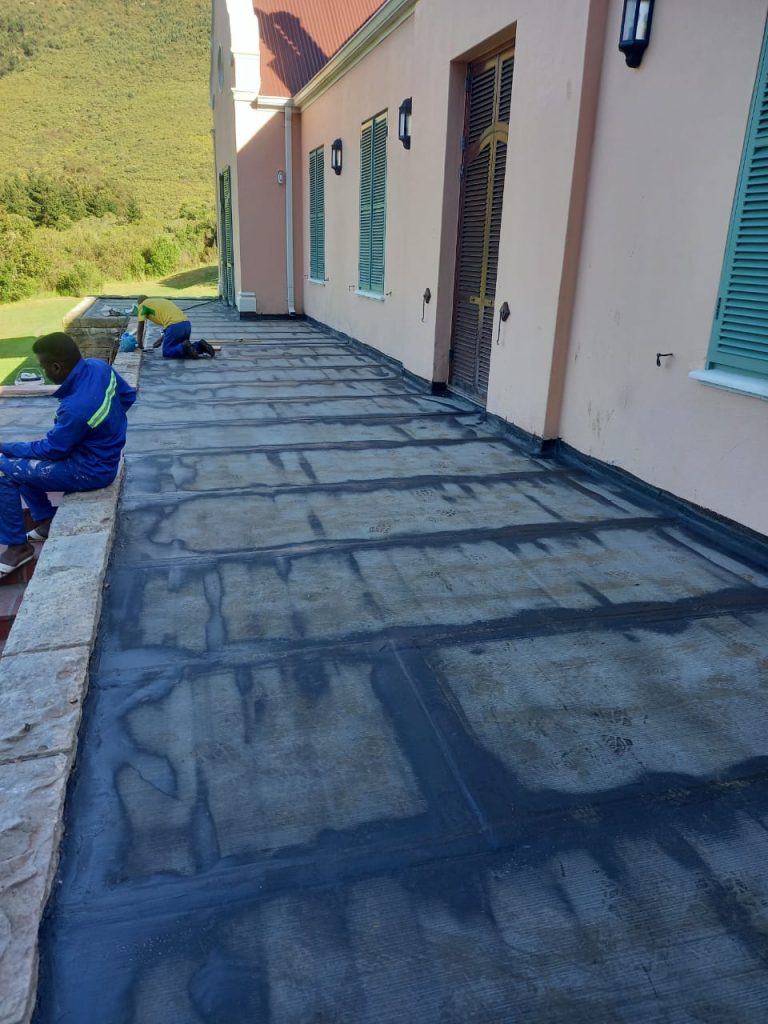
A reinforced bitumen sheet membrane, unrolled and bonded to the deck with a gas torch. It is the default for flat and low-pitch concrete roofs in South Africa.
- Single-layer 4mm: roughly R300 to R420 per m2 in Cape Town
- Double-layer 3mm plus 4mm: roughly R420 to R560 per m2
- Some national guides quote lower, around R200 to R380 per m2, usually for large simple decks
Strengths: thick, robust, proven, and long-lived when detailed properly. Weaknesses: it has seams, and seams at upstands and penetrations are where failures start. It also needs a competent applicator with an open flame on your roof.
When torch-on is the right answer
- A flat or low-pitch concrete slab
- A roof with reasonably simple geometry
- Where the deck is sound or can be made sound
- Where a long service life justifies the cost
Liquid acrylic coatings
A water-based coating, usually reinforced with a fabric membrane, rolled or brushed over the surface. It runs roughly R150 to R260 per m2 and is the cheapest credible system.
It is a refurbishment product. Over a sound existing substrate it does a decent job and is easy to recoat. It is not a repair for a roof with structural problems or standing water, and it will not last as long as a membrane.
- Best for: recoating an intact roof, tile roofs, small areas
- Worst for: ponding water, moving cracks, failing screeds
- Expect: a shorter cycle than torch-on, with recoating built into the plan
Liquid polyurethane
A seamless, flexible, high-performance liquid membrane. At R350 to R550 per m2 it is the most expensive of the three, and it earns that in two situations.
- Complex geometry. Many pipes, plant, awkward upstands. Seamless beats seamed.
- Long life brief. Where 20-plus years is the requirement rather than a hope.
PU coatings for higher-wear situations sit around R280 to R450 per m2. The distinction between a full PU membrane system and a PU topcoat matters, so ask which one is being quoted. Cape Town rainfall patterns are published by the NHBRC, which is worth checking before you plan outdoor work.
Comparing the three at a glance
- Cheapest to buy: acrylic, at R150 to R260 per m2
- Best value on a plain flat slab: torch-on single layer
- Best on a complicated roof: liquid polyurethane
- Longest life: a properly detailed double-layer torch-on or a full PU system
Rates alone will not decide it. Full costs per area of the house are set out in our waterproofing cape town price guide.
Flat roofs versus pitched roofs
These are genuinely different problems and it is worth being clear about which you have.
Flat concrete roofs
A flat roof is never truly flat. It should have a fall of roughly 1:80 to 1:100 so water runs to an outlet. If it ponds, no membrane will save it for long, because standing water finds every weakness.
- Check for ponding after rain and photograph it
- Screed-to-falls is a separate cost, not part of the membrane rate
- Outlets must be clear, correctly sized and properly dressed into the membrane
Pitched tile roofs
A pitched roof sheds water; it does not hold it. It usually does not need a membrane at all. Leaks come from broken tiles, failed ridge mortar, worn valleys and flashings, or blocked gutters.
Sealing the whole surface of a tile roof is rarely the right fix, and it can trap moisture underneath. Repair the defect first. Tile sealing at R120 to R200 per m2 is for genuinely porous concrete tiles, not for a leak with a specific cause. We cover this further in our guide to types of damp.
Metal and IBR sheet roofs
Failures here are typically at fixings, laps and flashings rather than across the sheet. Fix and seal the details, then coat the roof if it needs protection, not the other way round. Our guide to balcony waterproofing goes into this properly.
Roof waterproofing Cape Town homes need: what the weather does
Winter rainfall arrives on strong north-westerly fronts between May and August. Wind-driven rain is the local specialty, and it attacks details rather than open areas. If you are weighing that up, our guide to flat roof waterproofing is worth a read.
- Upstands and parapets take the wind and fail first
- South-easter summer wind deposits salt and grit that block outlets
- Strong UV ages coatings faster than in cooler climates
- Coastal salt corrodes fixings and flashings on the Atlantic Seaboard
Practical consequence: get the roof cleaned and the outlets cleared before April. A blocked outlet turns a functioning roof into a shallow pond, and ponding kills membranes. We cover this further in our guide to waterproofing guarantee.
Getting a roof quoted properly
Ask for the measured area, the named system and layer count, and preparation and detailing itemised. If the quote does not distinguish between open area and detailing, it is a guess. There is more detail in our piece on roof leak repair cape town.
Choosing between contractors is covered in our waterproofing companies cape town guide. If the water is actually coming from a wall rather than above, start with damp proofing cape town instead.
We assess roofs free with no call-out fee across Cape Town. Tell us what you are seeing and we will look before we quote. Our full waterproofing service covers flat roofs, balconies and walls.
Frequently asked questions
What is the best waterproofing for a flat roof in South Africa?
For a sound concrete flat roof with simple geometry, torch-on bitumen membrane is the usual answer at roughly R300 to R560 per square metre depending on the build-up. For roofs with complex geometry, many penetrations, or where a 20-year-plus life is specified, liquid polyurethane at R350 to R550 is better because it is seamless. Acrylic suits recoating a roof that is already sound. For the full picture, see our article on damp cape town winter.
Is torch-on better than liquid waterproofing?
Neither is better in general. Torch-on gives a thick, robust, proven membrane and suits plain flat decks, but it has seams and needs a skilled applicator with an open flame. Liquid systems are seamless, which is a real advantage on complicated roofs with many pipes and upstands. The right choice depends on the roof geometry, the substrate condition and the required service life.
How long does roof waterproofing last?
South African guidance puts quality systems at 10 to 25 years. Acrylic coatings sit at the short end and are designed to be recoated periodically. Well-detailed torch-on and full polyurethane systems reach the longer end. Ponding water, blocked outlets, foot traffic and coastal salt all cut those figures, which is why falls and drainage matter as much as the membrane itself.
Do I need to remove the old membrane before waterproofing a roof?
Only if it has failed or is incompatible. A sound, well-bonded existing layer can often be prepared and overcoated with a compatible system. Blistered, lifting or brittle material must be stripped, because the new membrane can only be as sound as what it is bonded to. Overcoating a failing layer is one of the most common causes of early failure.
Why does my flat roof still leak after waterproofing?
The three usual reasons are ponding water because the falls were never corrected, failed detailing at upstands, parapets and pipe penetrations rather than in the open field, and a blocked outlet backing water up above the upstand height. Membranes rarely fail across the middle of a roof. Check drainage and details first before assuming the product was wrong.