

Bathroom tiling Cape Town homeowners budget for lands at roughly R11,800 to R27,500 for a standard bathroom in 2026. Strip out the old tiles and add a full shower membrane under porcelain and it can reach R21,000 to R43,000.
The part that decides whether the bathroom lasts is not the tile. It is what goes underneath it.
What bathroom tiling Cape Town actually costs
A bathroom is a small floor and a large area of wall, which is why the totals surprise people.
- Floor tiling labour: R150 to R250 per m²
- Wall tiling labour: R180 to R300 per m²
- Large format over 600mm: R200 to R350 per m²
- Mosaic, often used in niches: R250 to R400 per m²
- Tiles themselves: ceramic R80 to R250 per m², porcelain R200 to R500
A typical bathroom has around 5m² of floor and 20m² to 28m² of wall. That wall area is where most of the labour sits, and it is why quoting on floor size alone is misleading.
The preparation lines
- Removing old tiles and adhesive: R50 to R150 per m²
- Rubble removal: R500 to R1,500 per load
- Levelling screed if the floor is uneven: R120 to R250 per m²
- Adhesive and grout: R50 to R150 per m²
A bathroom strip-out fills a small skip on its own. If rubble removal is not on the quote, ask where it is going.
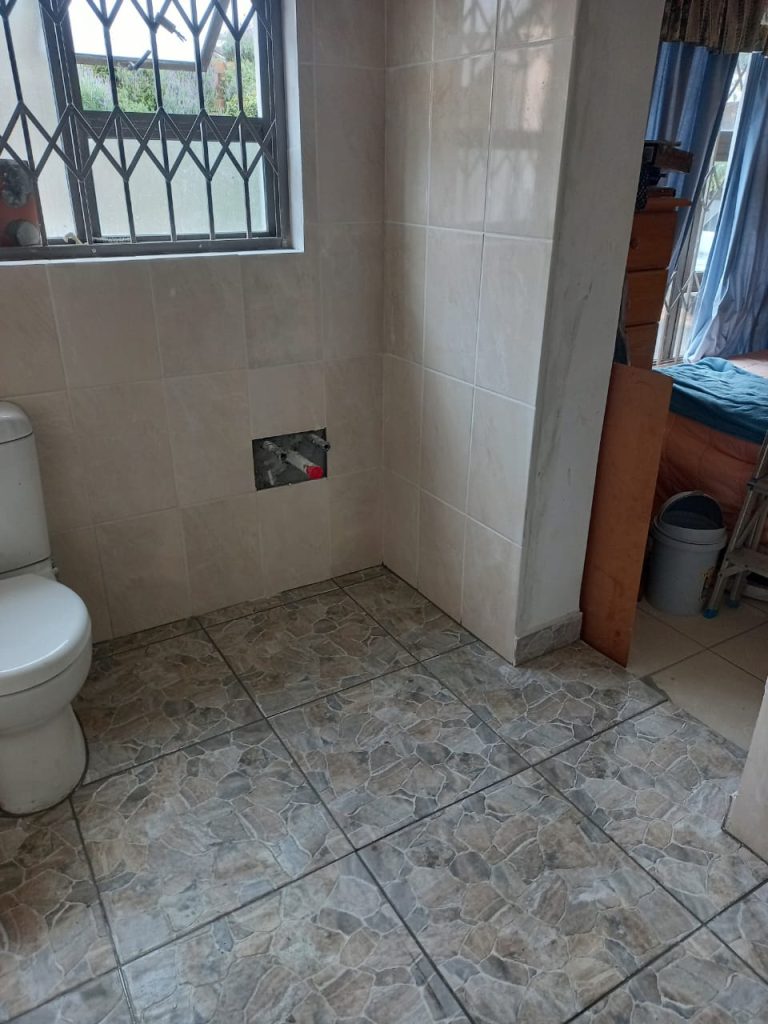
Waterproofing: the line you must not cut
Tiles are not waterproof and grout is not a seal. Water passes through grout joints, and the layer that stops it reaching your walls and slab sits underneath the tile.
- Cementitious tanking: roughly R150 to R220 per m²
- Liquid rubber membrane: roughly R180 to R280 per m²
- Sheet membrane with bonding: roughly R250 to R350 per m²
- Flat-rate small bathroom, shower only: around R2,500 to R4,500
- Flat-rate standard bathroom, shower plus floor: around R4,500 to R7,500
Across the market, shower waterproofing is quoted anywhere from R70 to R500 per m² depending on the system. Get the system named on the quote. If the bathroom sits above a living space, the consequences of getting it wrong are structural as well as cosmetic, which is where proper waterproofing work matters.
Where the membrane has to go
- The full shower floor, turned up the walls to at least shower-head height
- Every floor-to-wall junction, sealed as a continuous detail
- Around the drain outlet and any pipe penetrations
- Behind the bath where it meets the wall
- Any niche or shelf recessed into a wet wall
Corners and junctions are where failures start, because that is where the membrane has to bend rather than lie flat.
Falls to the drain
A shower floor must slope to the outlet, and that slope is built into the screed before the tiles are laid. Get it wrong and water pools in the corners no matter how good the tile is.
- The fall is formed in the screed, not created with adhesive under the tiles
- The waterproofing goes on after the fall is formed, so water runs on the membrane too
- Smaller tiles or mosaic follow a fall more easily than large-format tiles
- Linear drains allow a single-direction fall, which suits large tiles better
If you want 600×600 tiles on a shower floor, ask how the fall will be achieved before you buy them. It is a solvable problem, but it changes the drain choice. Tile and adhesive standards are published by the South African Bureau of Standards.
Choosing bathroom tiles that work
- Slip resistance matters more on a wet floor than on a wall
- Porcelain absorbs less water than ceramic, which suits wet areas
- Small floor tiles mean more grout lines, which help grip but need more cleaning
- Large wall tiles make a small bathroom feel bigger and reduce grout
- Buy 10% extra, or 15% for a patterned layout, and keep the spares
Cape Town’s coastal humidity makes ventilation part of the tiling decision too. A bathroom that never dries out will show mould in the grout regardless of the tile. For rates across the rest of the house, see our tiling Cape Town price guide.
A realistic sequence
- Strip out old tiles and remove rubble
- Repair and level the substrate, form the falls
- Apply the waterproofing system and let it cure
- Set out and tile walls, then the floor
- Grout, silicone the movement junctions, fit trims
Most standard bathrooms run several working days, with curing time between the waterproofing and tiling that cannot be rushed. Before you appoint anyone, work through our tiling contractors near me checklist and the guide to choosing tilers near me.
Getting your bathroom quoted
We quote bathroom tiling with the waterproofing system named as its own line, the wall and floor areas measured separately, and preparation priced rather than assumed. Free assessment and no call-out fee.
See our flooring and tiling services or send us your bathroom measurements for a written quote.
Frequently asked questions
How much does it cost to tile a bathroom in Cape Town?
Roughly R11,800 to R27,500 for a standard bathroom in 2026, covering floor and walls. Where old tiles are stripped out and a full shower membrane goes in under porcelain, the total can reach R21,000 to R43,000. Labour alone is R150 to R250 per m² on floors and R180 to R300 on walls.
How much does bathroom waterproofing cost?
Around R4,500 to R7,500 as a flat rate for a standard bathroom with a shower and floor, or R2,500 to R4,500 for a shower only. Per square metre, cementitious tanking is roughly R150 to R220, liquid rubber R180 to R280 and sheet membrane R250 to R350. The market range is R70 to R500 per m².
Do you need to waterproof before tiling a shower?
Yes. Tiles and grout are not a waterproof layer — water passes through grout joints. The membrane goes under the tile, across the full shower floor, up the walls to at least shower-head height, and continuously through every floor-to-wall junction, around the drain and behind the bath.
How long does it take to tile a bathroom?
Most standard bathrooms take several working days. The sequence is strip-out and rubble removal, substrate repair and forming the falls, waterproofing with curing time, then walls, floor, grouting and silicone. The waterproofing cure cannot be rushed, so a job promised in a single day has skipped something.
What tiles are best for a bathroom floor?
Porcelain absorbs less water than ceramic, which suits wet areas. Slip resistance matters more on the floor than the walls, and smaller tiles give more grout lines for grip and follow the fall to the drain more easily. Buy 10% extra, or 15% on a patterned layout, and keep the spares.