
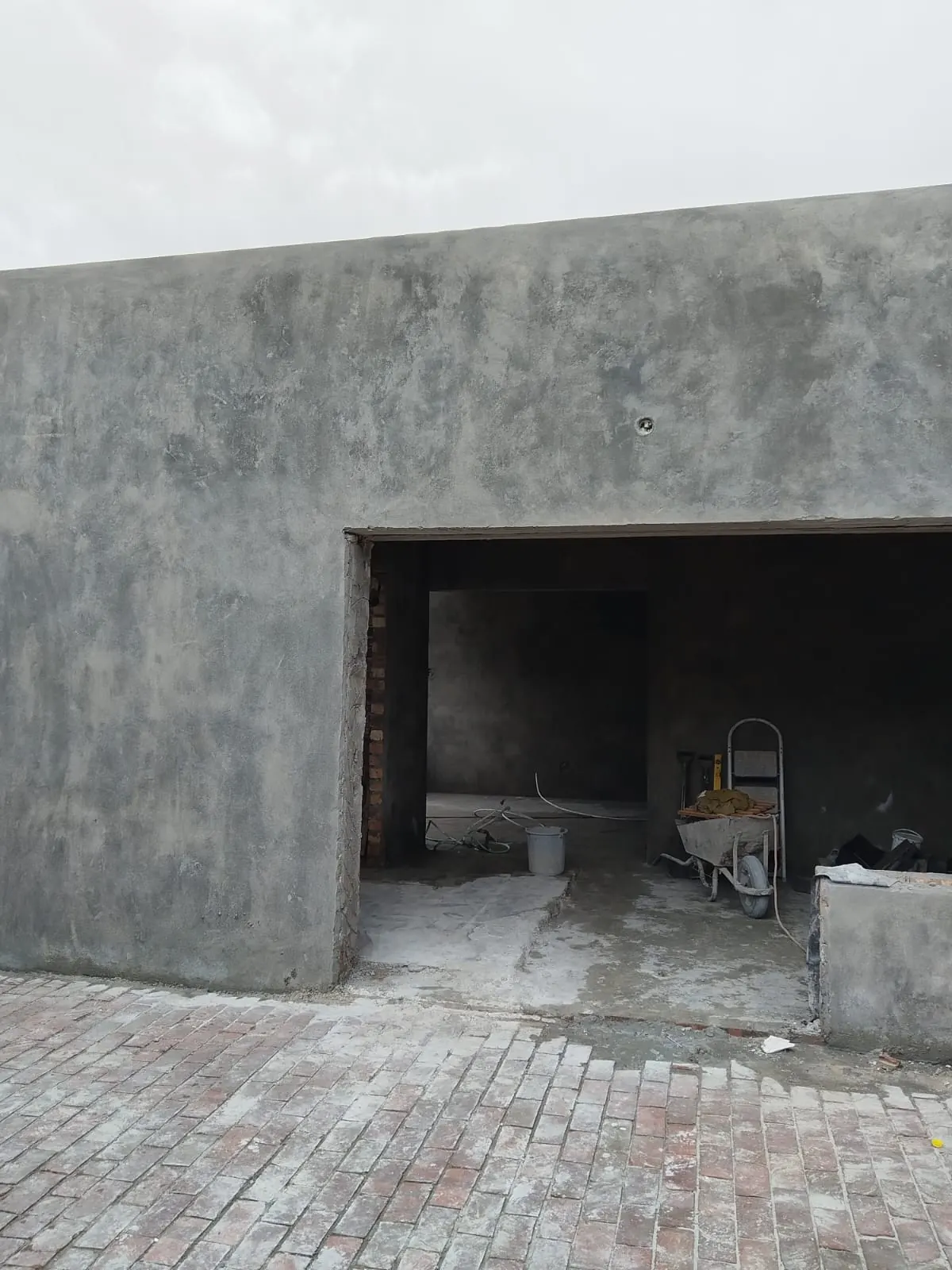
The 1 meter plaster sand price in Cape Town lands around R500 to R750 delivered in 2026, or nearer R430 to R560 if you collect it from a yard. A metre here means a cubic metre — one cube.
The more useful question is not what it costs. It is how much wall one cube actually covers, because that is what decides whether you order one or three.
What one cube of plaster sand covers
Working from standard plaster maths, one cubic metre of sand in a normal cement mix covers roughly:
- At 12mm thick: about 70 to 80 m² of wall
- At 15mm thick: about 55 to 65 m²
- At 20mm thick: about 45 to 50 m²
Those figures are before waste. Add ten percent for what ends up on the ground, in the wheelbarrow and stuck to the board, and a realistic planning number is 50 to 70 m² per cube on a normal wall.
Why your wall might use far more
The numbers above assume a reasonably true wall. Plenty are not.
- Uneven brickwork needs a thicker coat to come out flat, sometimes 25mm or more
- Old walls often need building up in patches before the finish coat
- Rough block soaks up more than smooth stock brick
- External work is usually laid thicker than internal
If a wall is visibly out of true, budget for closer to 40 m² a cube. The sand is the cheap part of that correction, so do not skimp on it.
Working out your own order
It takes two minutes with a tape measure.
- Measure each wall: height times width, in metres, to get m².
- Add the walls together. Subtract big windows and doors, not small ones.
- Divide by 60 for a normal wall, or by 40 for a rough one.
- Round up to the nearest half cube.
Example: a 12 metre run of wall at 2.4 metres high is about 29 m². That is comfortably inside a single cube, even with waste.
Real job examples at the 1 meter plaster sand price
- One average bedroom, four walls: around 35 to 45 m². One cube.
- A single external side elevation: often 30 to 50 m². One cube, sometimes with a little left.
- Boundary wall, both faces, 15 metres long: around 55 to 65 m². One cube if the wall is true, more if it is not.
- Whole house exterior: well past a single cube — order in bulk.
On that last one, the per-cube rate falls sharply once you go up to a full load. The steps are set out in our 3 meter plaster sand price guide, and it is usually cheaper to order six cubes at once than three cubes twice.
Ordering a single cube without wasting money
One cube is the awkward size. It is too much to carry in bags and too little to attract a good delivery rate.
- Ask whether delivery is included before comparing two quotes
- Check the minimum load. Some suppliers will not deliver under three cubes at all
- Combine orders with cement and stone from the same yard, one delivery fee
- Have a tip spot ready close to the work, on a hard surface
- Cover the heap — wet sand throws your mix ratios out
If your job genuinely only needs a fraction of a cube, bagged material may be cheaper once delivery is counted. We work that break-even out in the plaster sand 40kg price comparison.
What else the cube needs
Sand alone is not plaster. You also need cement, and the mix ratio changes how far the sand goes.
- 1:4 sand to cement — stronger, used externally, uses more cement
- 1:6 — common internally, slightly more sand per bag of cement
- Clean water and a mixing area you do not mind ruining
When one cube is the wrong answer
If you are measuring a whole house, stop measuring cubes and get the wall quoted as a finished job. Published South African plastering labour runs around R90 to R160 per square metre in 2026, and that number dwarfs the sand. Mix ratios and workmanship standards are published by the South African Bureau of Standards.
Buying material for a job you are not doing yourself rarely saves anything either. Contractors buy at trade rates and carry the waste risk.
For the full rate picture see our plastering sand price guide. To have the wall done properly, look at our plastering services or send us the measurements for a free written quote.
Frequently asked questions
How much is 1 meter plaster sand?
About R500 to R750 delivered in the Cape Town area in 2026, or roughly R430 to R560 collected from a merchant’s yard. A metre in this context means one cubic metre, usually called a cube. Delivery is the reason the delivered figure is so much higher, because a single cube carries the full cost of the truck.
How much plaster sand do I need per m2?
Roughly 0.015 to 0.02 cubic metres of sand per square metre of wall at a normal 12mm to 15mm plaster thickness. Put the other way round, one cube covers about 50 to 70 square metres in practice once waste is counted. A rough or out-of-true wall can drop that to around 40 square metres because the plaster has to make up the unevenness.
How much is 1 cube of plaster sand at a builders merchant?
Large South African merchants published bulk yard rates of roughly R430 to R560 per cubic metre in 2026, with premium washed plaster sand reaching around R900. Merchant yard prices exclude delivery in almost every case, so a cube collected and a cube delivered are two different numbers for the same material.
How many square metres does a cube of plaster sand cover?
About 70 to 80 square metres at 12mm thick, 55 to 65 at 15mm and 45 to 50 at 20mm, before waste. A safe planning figure for an ordinary wall is 50 to 70 square metres per cube. Uneven brickwork, old walls needing building up and rough block all pull that number down considerably.
Is it cheaper to buy plaster sand by the cube or in bags?
By the cube, for anything beyond a small repair. One cubic metre weighs roughly 1,500kg, which is about 37 to 38 forty-kilogram bags. At bag prices that works out far higher per cubic metre than bulk sand costs. Bags only win on very small jobs where you would otherwise pay a full delivery fee for a fraction of a load.