

Kitchen tiling Cape Town jobs split into three separate pieces of work: the floor, the walls, and the splashback. Each is priced differently, and confusing them is why kitchen quotes are so hard to compare.
Here is what each one costs in 2026, and the decisions that change the number.
Kitchen tiling Cape Town costs, piece by piece
- Floor tiling labour: R150 to R250 per m²
- Wall and splashback labour: R180 to R300 per m²
- Large format over 600mm: R200 to R350 per m²
- Mosaic sheets on a splashback: R250 to R400 per m²
- Kitchen floor and splashback all in: commonly R90 to R500 per m² depending on tile
A small splashback of about 4m² typically comes to R2,000 to R4,000 all in, and climbs toward R6,000 with imported or patterned tile. Kitchen wall tiles start around R159.90 per m² at major South African retailers.
Floor versus wall: they are not the same job
Wall tiling is slower per square metre than floor tiling. Gravity works against the tiler, battens and levels have to be set up, and joints sit at eye height where every misalignment is visible.
That is why wall rates sit R30 to R50 per m² above floor rates. A quote that uses one blended rate for both is either rounding up your floor or under-pricing your walls.
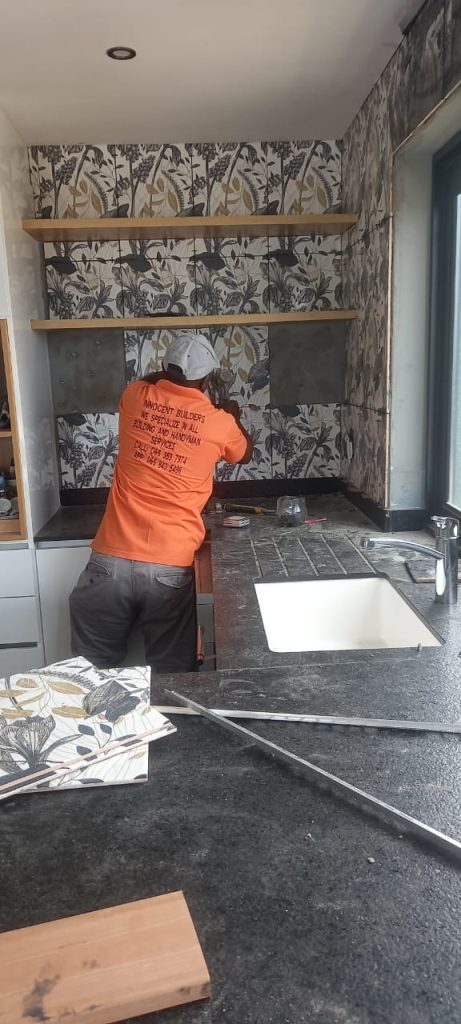
Working around cabinetry
The biggest cost decision in a kitchen is whether you tile under the units or up to them. Both are legitimate, and they suit different situations.
- Tile the whole floor, then fit units: more tile and more labour, but the floor is continuous if you ever change the layout
- Tile up to the units: saves tile and labour, but locks the kitchen layout in place
- Either way, deduct the cabinet footprint from a measured quote if you are not tiling under them
- Appliance recesses should be tiled, so a dishwasher or fridge sits at the right height
If your kitchen is being replaced, tile before the units go in. If only the floor is changing, tiling up to the plinths is usually the sensible call.
Order of works matters
- Strip out old finishes and remove rubble
- Level the floor if needed, at R120 to R250 per m²
- Tile the floor, including any appliance recesses
- Fit cabinetry and worktops
- Tile the splashback last, so it sits tight to the worktop
Splashbacks fitted before the worktop almost always end up with a gap or an awkward cut. If joinery is part of the project, our carpentry team can sequence the two together.
Splashbacks: small area, high visibility
A splashback is a few square metres in the most looked-at part of the room, which is why it is worth spending time on. Tile and adhesive standards are published by the South African Bureau of Standards.
- Measure the actual run, worktop to underside of the wall units, not the whole wall
- Decide the layout first: straight brick bond, stacked, or herringbone
- Patterns add 30% to 50% to the labour, and 15% to the waste allowance
- Plan the cuts around sockets, so a switch does not land on a joint
- Silicone, not grout, where the tile meets the worktop, because that junction moves
Behind a gas hob, check the tile is suitable for the heat. Behind a sink, the seal at the worktop matters more than the tile you choose. Where sockets need moving to suit the layout, that is electrical work to arrange before tiling starts.
Choosing kitchen tiles that survive a kitchen
- Porcelain on the floor handles dropped pans and spills better than ceramic
- Slip resistance matters in front of the sink and dishwasher
- Darker grout on a kitchen floor stays looking clean far longer
- Gloss on walls wipes down easily; matt hides water marks but holds grease
- Large floor tiles mean fewer grout lines to scrub
Buy 10% extra on a straight lay and 15% on a pattern, and keep the leftovers. Ranges get discontinued and dye lots vary between batches, so those spares are your only guaranteed match for a future repair. Our tiling Cape Town guide covers the rates behind every line here.
Tile or another floor finish?
Tile is not automatically the right kitchen floor. Vinyl is warmer underfoot and cheaper, laminate is not ideal near a sink, and tile wins on water and heat resistance. Our comparison of flooring installation options weighs them up properly.
Getting your kitchen quoted
We measure the floor, the wall area and the splashback run separately, deduct cabinet footprints where you are not tiling under units, and sequence the work around joinery so nothing gets cut twice. Free assessment and no call-out fee across Cape Town.
Before appointing anyone, it is worth reading our checklist for vetting tiling contractors near me. When you are ready, see our flooring and tiling services or send us your kitchen measurements.
Frequently asked questions
How much does it cost to tile a kitchen in South Africa?
Kitchen floors and splashbacks commonly run R90 to R500 per m² all in, depending on the tile. Labour alone is R150 to R250 per m² on floors and R180 to R300 on walls. A small splashback of around 4m² typically totals R2,000 to R4,000, rising toward R6,000 with imported or patterned tile.
How much does a kitchen splashback cost to tile?
Around R2,000 to R4,000 for a typical 4m² run, covering roughly R900 to R1,500 of labour and R1,000 to R2,500 of tile and adhesive. Patterned layouts such as herringbone add 30% to 50% to labour and 15% to the waste allowance. Kitchen wall tiles start near R159.90 per m² at SA retailers.
Should you tile under kitchen cabinets?
Both approaches are used. Tiling the whole floor first costs more in tile and labour but leaves a continuous floor if you ever change the layout. Tiling up to the units saves money and locks the layout in. Either way, deduct the cabinet footprint from the measured area if you are not tiling beneath them.
Do you tile the floor or the walls first in a kitchen?
Floor first, then fit the cabinetry and worktops, then tile the splashback last so it sits tight to the worktop. A splashback tiled before the worktop is installed almost always leaves a gap or an awkward cut at the bottom. Plan socket positions before any tiling begins.
What tiles are best for a kitchen floor?
Porcelain handles dropped pans, spills and heavy traffic better than ceramic. Choose slip resistance for the areas in front of the sink and dishwasher, and darker grout to stay looking clean. Larger tiles mean fewer grout lines to scrub. Order 10% extra, or 15% on a pattern, and keep the spares.