
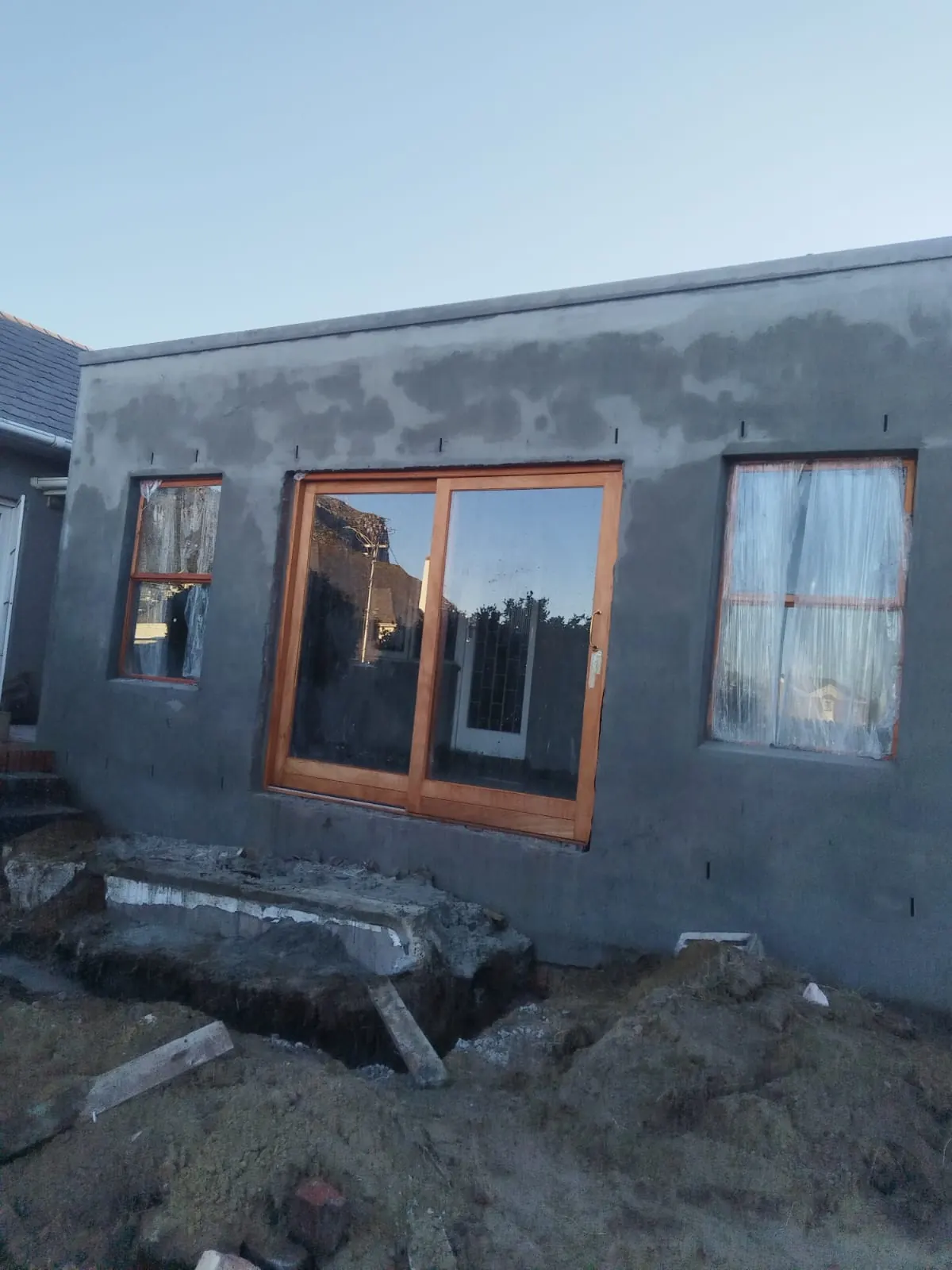
Wall plastering is the sand-and-cement coat that turns rough brickwork into a flat, paintable surface. In Cape Town it costs R90 to R160 per square metre internally and R130 to R200 externally in 2026, materials and labour included.
It is also the layer that decides whether your paint lasts eight years or eight months. Here is what it actually involves.
What wall plastering does for a house
Plaster is not decoration. It does four jobs at once.
- Levels the wall so paint, tiles and skirting sit true
- Seals the masonry against wind-driven rain, which matters on the Cape Peninsula
- Protects the brick from frost, salt and general weathering
- Gives paint something stable to bond to
Skip it or rush it and every finish above it fails early. Paint peeling in strips is nearly always a plaster problem wearing a paint costume.
The two-coat system
The South African standard is two coats, not one heavy pass.
- Scratch coat — around 10 to 12mm, a stronger mix, keyed with a comb before it sets
- Finish coat — around 5 to 8mm, a finer mix, floated smooth
Total thickness lands near 15 to 18mm. Two thinner coats shrink less than one thick one and crack far less as a result. The ratios for each are in our cement plaster mix ratio guide.
Preparation decides the outcome
Most failures are set before any plaster is mixed.
- Loose material, oil, paint and efflorescence must come off first
- Active damp has to be fixed, not covered
- Smooth concrete needs a bonding agent such as a PVA-cement slurry
- Normal fired brick just needs a good wetting down
Plaster applied over a bone-dry wall pulls its water into the brick and never gains strength. Tap a cured wall with a knuckle — a hollow sound means it has let go and that section has to be cut out.
Interior versus exterior wall plastering
Same trade, different specification.
- Interior: weaker mix, smoother finish, usually painted directly
- Exterior: stronger mix, waterproofing additive, float finish, more surface preparation
- Double storey: add scaffolding, generally R8 to R15 per square metre
The full breakdown sits in our plastering walls comparison, which covers the coastal salt problem specific to Cape Town in detail.
What wall plastering costs in 2026
- Internal two-coat sand-cement: R90 to R160 per m2
- External two-coat with waterproofer: R130 to R200 per m2
- Skim coat over sound existing plaster: R50 to R90 per m2
- Labour only: roughly R35 to R100 per m2
Cape Town sits at the upper end of national ranges, and other 2026 sources put labour-only work at R77 to R132 per m2. Where estimates disagree, the driver is almost always coat count and wall condition rather than the plasterer’s day rate.
Why quotes differ so much
- One coat or two. A single-coat quote will always look cheaper.
- Whose materials. Some rates are labour only.
- Wall condition. Hacking off old plaster is a separate job.
- Access. Height and tight side passages add hours.
Ask every contractor to price coats, materials and preparation separately. Two numbers that look R40 apart per square metre are often not describing the same work at all.
Cracks: which ones matter
Not every crack is a problem, but they are not all cosmetic either.
- Fine map cracking (crazing): a mix too rich, or drying too fast. Surface issue.
- Straight cracks along a joint: movement between two materials. Needs the right filler.
- Diagonal cracks from corners of openings: structural movement. Get it looked at.
- Cracks with damp staining: water is getting in behind. Fix the source first.
Filling and painting over a moving crack simply buys a few months. Anything wider than a business card or growing month by month deserves an opinion before you redecorate.
Curing and painting
Fresh plaster must stay damp for three to seven days while the cement hydrates. Mist it lightly twice a day, or shade it. In a Cape Town summer wind this is not optional. Mix ratios and workmanship standards are published by the South African Bureau of Standards.
Then wait. New plaster needs a minimum of 28 days before painting, and an alkali-resistant primer as the first coat. If you want a glass-smooth finish rather than a floated one, a skimming plaster price is quoted separately on top.
Doing it yourself or hiring
Patching a hole is realistic. A full wall is a skill that takes years, because flat and plumb over three metres is genuinely hard and the mistake is only visible once the paint is on.
Our brickwork and plastering team works across the Peninsula and Northern Suburbs. Assessment is free and we charge no call-out fee — send us photos and rough measurements for a written quote.
Frequently asked questions
What is plastering?
Plastering is applying a cement and sand mortar to brick or block walls to create a flat, sealed surface ready for paint or tiles. In South Africa it is normally done in two coats: a stronger scratch coat around 12mm thick, then a finer finish coat of 5 to 8mm floated smooth. It levels the wall, weatherproofs it and gives paint a stable surface to bond to.
How much does it cost to plaster walls?
In 2026 South African rates run R90 to R160 per square metre for internal two-coat sand-cement plaster including materials and labour, and R130 to R200 per square metre externally where a waterproofing additive is used. A skim coat over sound existing plaster is cheaper at R50 to R90 per square metre. Cape Town sits toward the top of those ranges.
How much does it cost to plaster a room?
Measure the wall area rather than the floor. A 4m by 4m room with 2.7m ceilings has roughly 43 square metres of wall before deducting a door, so at R90 to R160 per square metre expect somewhere around R3,900 to R6,900 for internal two-coat plaster. Hacking off failed old plaster first is quoted as a separate item.
How long should plaster dry before painting?
A minimum of 28 days for sand-cement plaster under normal conditions. Painting earlier traps moisture in the wall and the coating bubbles and peels within months. Keep the plaster damp for the first three to seven days so the cement cures properly, then let it dry out fully and use an alkali-resistant primer as the first coat.
Why does new plaster crack?
Usually one of three reasons: the mix was too rich in cement so it shrank hard, it dried too quickly in wind or heat, or it was never cured. Fine map cracking across a wall is a surface defect from those causes. Straight diagonal cracks running from the corners of doors and windows are different and suggest structural movement worth investigating.