

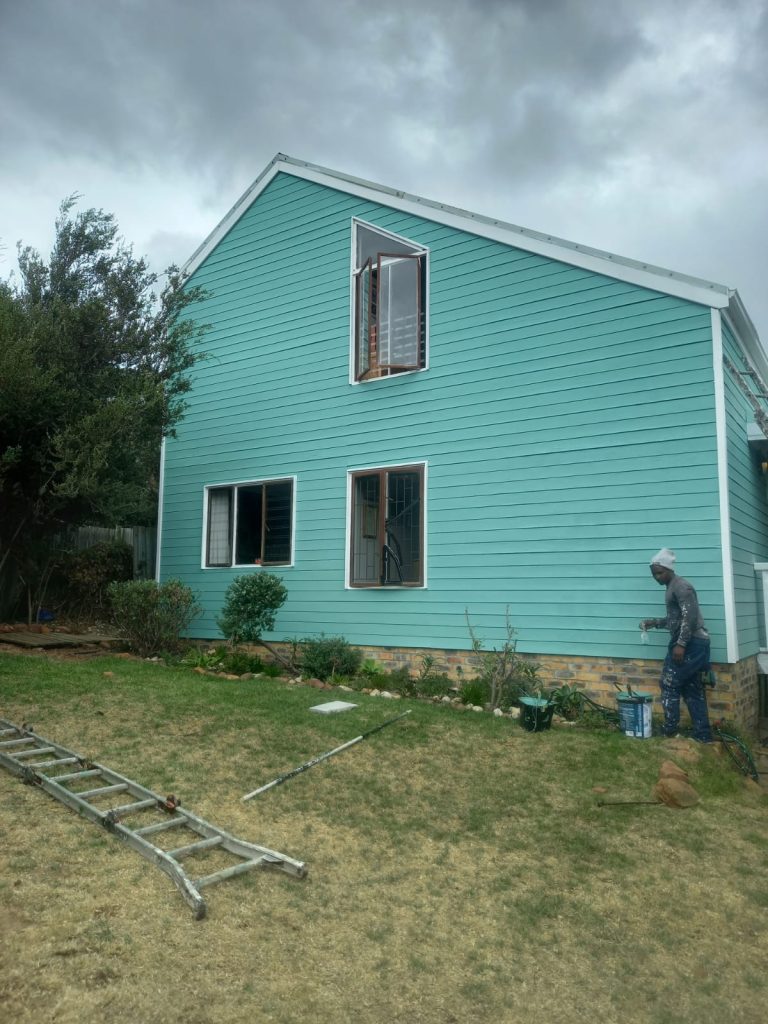
Homeowners asking how often repaint house exteriors in Cape Town get a general answer of every five to ten years. In practice, a good acrylic system on well-prepared walls in the Western Cape lasts around eight years, and coastal properties sit at the shorter end.
The interval is not a fixed rule. It depends on exposure, paint quality and how well the last job was prepared. Here is how to work out where your house sits.
How often repaint house exteriors in a coastal climate
Cape Town stacks several kinds of wear on top of each other, which is why local intervals are shorter than the international guidance you find online.
- Salt-laden air settles on walls, draws moisture and attacks adhesion from underneath
- High UV breaks down binders, causing fading and chalking
- The south-easter drives sand and salt at exposed elevations
- Winter rainfall keeps south-facing walls damp for months
- Big daily temperature swings make substrates expand and contract
A house in Blouberg or on the Atlantic Seaboard will need attention sooner than an identical house in Durbanville. Elevation matters too: the north and west walls take the UV and usually fail first.
Typical intervals by surface
- Exterior walls, quality acrylic: 7 to 10 years inland, 5 to 8 on the coast
- Exterior walls, budget paint: 3 to 5 years
- Roof coatings: 8 to 10 years for premium, 4 to 6 for cheap paint
- Timber windows, doors and trim: 2 to 4 years, sooner if sea-facing
- Steel gates, burglar bars and railings: whenever rust appears, not on a schedule
Interior repaint intervals
Inside, wear is about traffic and cleaning rather than weather.
- Hallways, kitchens and children’s rooms: every 4 to 6 years
- Living rooms and bedrooms: every 5 to 10 years
- Ceilings: every 8 to 10 years
- Bathrooms: sooner if extraction is poor and mould appears
- Skirtings and door frames: often need attention before the walls do
Interior repaints are usually driven by appearance rather than protection, which gives you flexibility on timing. Our guide to house painting cost Cape Town sets out what to budget when you do it.
Warning signs you should not wait out
Ignore the calendar and look at the walls. These signs mean the coating has stopped protecting the substrate.
- Chalking. Wipe a wall with a dark cloth. Powdery residue means the binder has failed.
- Fading. Compare a sheltered patch behind a downpipe with an exposed elevation.
- Hairline cracking. The paint film has lost flexibility.
- Flaking or peeling. Adhesion is gone and water is getting behind the film.
- Bubbling. Usually moisture pushing out from inside the wall.
- Persistent algae or black staining. Common on damp south-facing walls.
Bubbling and staining near skirtings are different from ordinary wear. They usually point at a moisture path rather than tired paint, and repainting over them changes nothing. Our guide to waterproofing Cape Town costs explains how that is diagnosed and priced.
Why repainting on time is cheaper
Waiting until the paint has completely failed does not save money. It moves cost from the paint line to the preparation line, and preparation is charged in hours.
- Sound but faded walls need a wash and two coats
- Chalked walls need thorough scraping and a stabilising primer
- Peeling walls need scraping back, filling and priming across large areas
- Exposed plaster can mean crack repair or patch replastering
- Water in the wall means fixing the source before painting at all
Repainting a sound wall is a straightforward job. Rescuing a neglected one can cost double for the same finished result.
How to stretch the interval
You can add years to a paint job without spending much.
- Rinse coastal walls with fresh water once or twice a year to remove salt
- Clear gutters and downpipes so overflow does not run down the facade
- Cut back shrubs touching walls, which trap damp and feed algae
- Touch up rust spots on bars and gates immediately
- Repaint sun-facing elevations alone if the rest is still sound
Repainting just the exposed elevations is a legitimate strategy on coastal homes. It costs a fraction of a full repaint and keeps the protective film intact where it matters most. Our guide to painting contractors Western Cape homeowners use covers how to brief that kind of partial job.
Planning your next repaint
Write down the month your house was last painted and what product was used. That single note makes the next decision far easier, and a guarantee is worthless if you cannot say when work was done. Paint performance standards in South Africa are set out by the South African Bureau of Standards.
If you are unsure whether your walls need repainting now or in two years, an inspection will tell you. See our painting services or send us the details for a free assessment with no call-out fee.
Frequently asked questions
How often should you repaint your house?
Exterior walls generally need repainting every five to ten years. In the Western Cape, a quality acrylic system on well-prepared walls commonly gives about eight years, and coastal homes exposed to salt air and strong UV sit at the shorter end of that range.
How often should interior walls be repainted?
High-traffic areas such as hallways, kitchens and children’s rooms typically need repainting every four to six years. Living rooms and bedrooms can go five to ten years, and ceilings often last eight to ten. Interior timing is driven by appearance rather than protection.
How often should a roof be repainted?
Roughly every eight to ten years for a premium acrylic roof coating on a properly prepared and cleaned roof. Cheaper low-binder roof paints fade and chalk within four to six years. Coastal roofs exposed to salt and high UV should be checked at the earlier end.
What are the signs that a house needs repainting?
Chalking that leaves powder on a cloth, visible fading against sheltered areas, hairline cracking in the paint film, flaking or peeling, bubbling, and persistent algae or black staining on damp elevations. Bubbling and staining near skirtings usually indicate a moisture problem rather than tired paint.
Does salt air affect how often you need to paint?
Yes, significantly. Airborne salt settles on walls, draws moisture and undermines paint adhesion from underneath, while coastal UV and wind-driven sand accelerate wear. Homes in areas such as Blouberg, Table View and the Atlantic Seaboard commonly need repainting years earlier than comparable inland properties.