
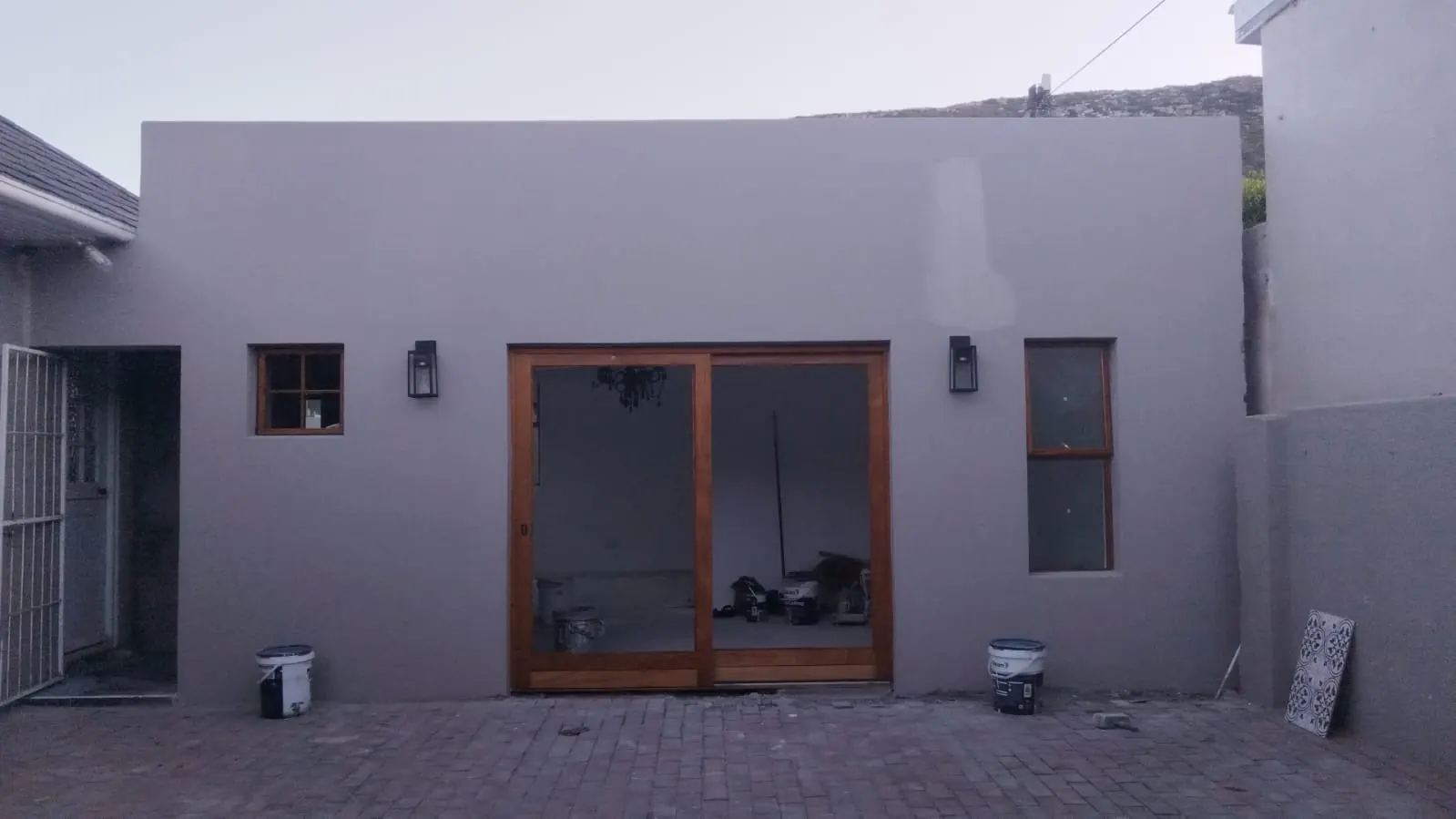
Feature wall painting is the cheapest way to change how a room feels. One wall, a few litres of paint, and a space reads completely differently for a fraction of a full repaint.
Textured and decorative finishes go further, and cost more. In 2026 speciality and textured finishes in South Africa typically run R100 to R200 per m2, against roughly R25 to R55 per m2 in labour for an ordinary interior wall.
What feature wall painting actually involves
A plain colour feature wall is the simplest version and by far the most common.
- One wall in a contrasting or deeper colour, usually two coats
- Paint cost is small, because a single wall in a bedroom is often under 10 m2
- The labour is in the cutting in, since every edge against the adjacent walls and ceiling has to be dead straight
- Wall condition matters more, because dark and matt colours show every dent and filler mark
That last point catches people out. A strong colour is unforgiving, so a wall that looked fine in magnolia often needs filling and sanding before it will carry a deep charcoal or navy.
Textured and decorative finishes
Texture adds depth that flat paint cannot. It also adds labour, material and permanence.
- Textured coatings: rolled or sprayed acrylic finishes with a fine to coarse grain, common on exteriors and in living areas
- Gamazine and marmoran-style finishes: granular decorative coatings applied by trowel
- Bagged or rough plaster look: a rustic finish achieved in the plaster rather than the paint
- Concrete and cement-effect finishes: flat but tonal, popular in modern interiors
- Metallic and pearl glazes: applied over a base coat, they shift with the light
What textured finishes cost
- Speciality and decorative finishes: roughly R100 to R200 per m2, and higher for hand-applied work
- Standard textured coating on exterior walls: about R75 to R110 per m2 for the coating itself, plus crack repair and prep
- Textured exterior painting labour: roughly R45 to R65 per m2, against R35 to R55 for smooth plaster
- Paint consumption: a textured surface uses around 25 per cent more paint than a smooth one
The extra cost is real work, not a premium. Texture increases the actual surface area, so more material is needed, and hand-applied finishes are slow by nature. Our painters near me guide gives the standard smooth-wall rates for comparison.
Where a feature wall works, and where it does not
Choosing the right wall matters more than choosing the right colour.
- Pick the wall the eye already goes to: behind a bed, behind a sofa, or around a fireplace
- Pick a wall with few interruptions. Doors, windows and switches break up the effect
- Consider the light. A dark feature wall on the wall opposite the window looks rich; on the window wall it can read as a shadow
- Avoid the wall you walk past rather than look at, such as a passage side wall
In a small room a feature wall can make the space feel smaller if it is the far wall, and deeper if it is on a short end wall. Trying a large test patch and living with it for two days beats any colour chart.
The part people forget: removing it later
A painted feature wall is easy to undo. Two coats of the surrounding colour and it is gone, which is exactly why it is such a low-risk change.
Textured finishes are a different matter, and this is worth knowing before you commit.
- Texture cannot be painted flat. The grain shows through any number of coats
- Removal means mechanical work: chipping or grinding the coating off, then re-plastering
- Budget it as a plastering job, not a painting one, because the wall usually needs skimming afterwards
- Wallpaper over texture rarely works, since the grain telegraphs through the paper
If you like the idea of texture but are not certain, a single feature wall is a far safer place to try it than a whole room. Getting back to a flat wall afterwards is a skimming job, and one wall is a much smaller bill than four.
Getting it done properly
Straight lines, even coverage on a deep colour and a consistent texture across a whole wall are all harder than they look. A visible join in a hand-applied finish is very difficult to correct afterwards. Paint performance standards in South Africa are set out by the South African Bureau of Standards.
Our painting team quotes feature walls and textured finishes per square metre with the preparation itemised, so you can see what you are paying for. If you are still comparing contractors, the painters Cape Town guide covers what to check. We do a free assessment with no call-out fee, so send us the wall dimensions and the finish you have in mind.
Frequently asked questions
How much does a feature wall cost to paint?
A plain colour feature wall is priced like any interior wall, roughly R25 to R55 per m2 in labour for two coats, so a small bedroom wall is often only a few hundred rand plus paint. Textured and decorative finishes are the expensive version, typically R100 to R200 per m2 in 2026.
What does a textured wall finish cost per square metre?
Speciality and decorative finishes generally run R100 to R200 per m2, with hand-applied trowel finishes at the top of that band. A standard textured coating on exterior walls costs about R75 to R110 per m2 for the coating alone, before crack repair and preparation are added to the quote.
Which wall should be the feature wall?
The wall your eye already goes to when you enter the room, usually behind the bed, behind the sofa or around a fireplace. Choose one with few doors, windows or switches breaking it up. Avoid passage side walls you walk past rather than look at, and consider how the room light falls before deciding.
Can a textured wall be made smooth again?
Not by painting over it, because the grain shows through any number of coats. Removal means chipping or grinding the coating off and then re-plastering or skimming the wall flat. Budget it as a plastering job rather than a painting one, which is why testing texture on a single wall first is sensible.
Do feature walls make a room look smaller?
It depends on placement. A dark colour on the far wall of a small room draws that wall in and can shrink the space, while the same colour on a short end wall adds depth. Light direction matters too, so paint a large test patch and live with it for a couple of days before committing.