

The cost to paint a house Cape Town homeowners actually live in lands between R28,000 and R55,000 for a single-storey three-bedroom exterior in 2026, and R55,000 to R95,000 or more once you add a second storey.
Those ranges are useless on their own. So below we take one ordinary house and add the numbers up properly, line by line, the way a quote should be built.
The house we are pricing
A standard Cape Town three-bedroom, single-storey home in the Northern Suburbs. Face plaster, no cladding, painted about seven years ago and now chalking on the north wall.
- Exterior wall area: roughly 280 m2
- Interior wall and ceiling area: roughly 340 m2
- External doors: 3
- Boundary wall: 40 m of plastered wall, both sides
- Condition: sound plaster, hairline cracks, one damp patch behind a downpipe
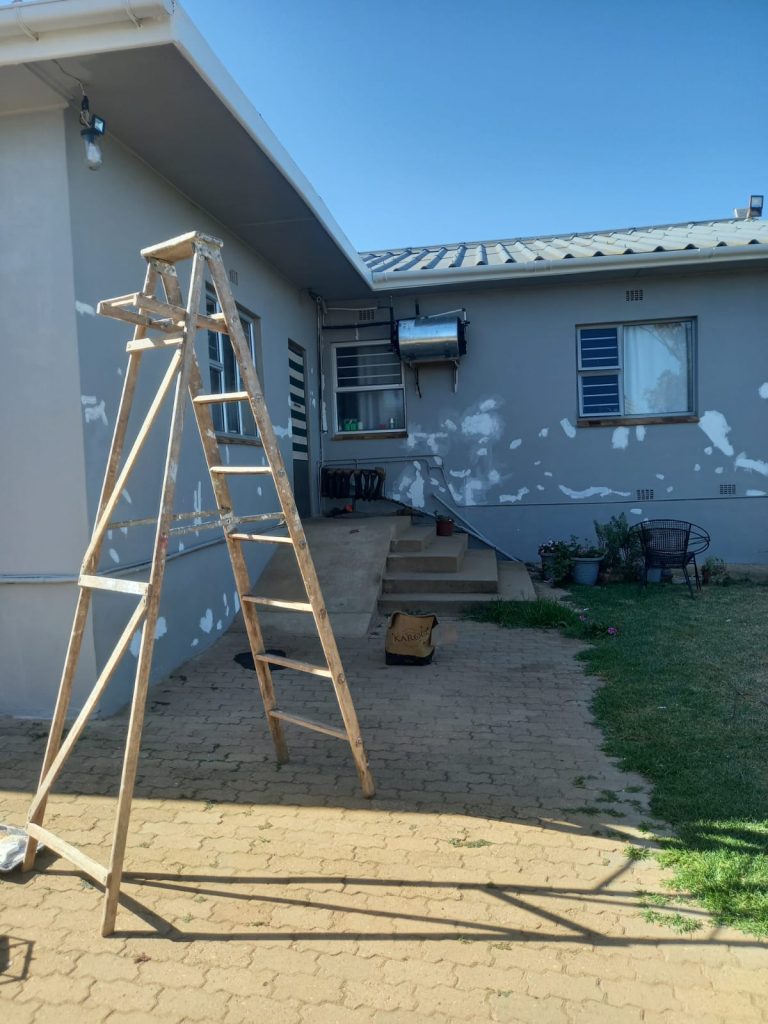
Working out the cost to paint a house Cape Town style, step by step
Painters price the same job three ways: per square metre, per room, or as a fixed project figure. Done honestly they land in the same place. We will use the per-square-metre route because it is the easiest to check.
Step 1 — exterior walls
Exterior painting runs roughly R35 to R75 per m2 for labour, or R70 to R160 per m2 when the quote includes paint. On 280 m2, an all-in mid-market figure of R120 per m2 gives R33,600.
Step 2 — the extras that always appear
- Three external doors at R300 to R700 each: R900 to R2,100
- Boundary wall, 40 m both sides at roughly 2 m high is 160 m2, at R70 per m2: R11,200
- Crack repair and filling on a sound wall: usually R2,000 to R5,000
- Damp patch behind the downpipe: R5,000 upward, and it must be fixed first
Add the exterior walls, doors and crack repair and you are at roughly R37,000 to R41,000 before the boundary wall. That sits neatly inside the published R28,000 to R55,000 band, and our house painting cost Cape Town guide breaks the per-square-metre rates down further.
Step 3 — the interior, if you do it at the same time
Interior painting is cheaper per square metre: roughly R25 to R55 per m2 for labour, or R50 to R120 per m2 including paint. A full interior repaint of a three-bedroom Cape Town home came in at R18,000 to R40,000 across 2026 sources.
What a double-storey does to the number
A double-storey three or four-bedroom home is not simply double the price. Wall area rises by perhaps 70 percent, but access changes everything.
- Scaffolding: R3,000 to R8,000 depending on size and how long it stands
- Slower work rate at height, so more labour hours per square metre
- Gables and high fascias that need proper edge preparation
Realistically, budget R55,000 to R95,000 for a double-storey exterior repaint, and past R100,000 for large estate homes. Choosing between quotes at that level is worth doing carefully, which is what our painting contractors checklist is for.
How much paint the job actually needs
Coverage is the easiest part of a quote to verify yourself. Most acrylic wall paints cover 10 to 12 m2 per litre per coat on a sealed, smooth surface.
- 280 m2 of wall, two coats, at 11 m2 per litre = about 51 litres
- That is three 20 litre tins, plus a margin for touch-ups
- A 20 litre premium exterior acrylic retails around R2,000 to R2,900
- So paint alone is roughly R6,000 to R8,700 on this house
New or previously unpainted plaster drinks far more on the first coat, and rough or textured surfaces can drop coverage to 6 or 7 m2 per litre. Paint performance standards in South Africa are set out by the South African Bureau of Standards.
What pushes the price up or down
Two identical houses can be R15,000 apart. The difference is almost always preparation and specification, not profiteering.
- Surface condition — chalking, flaking and cracks all add labour hours before a drop of paint goes on
- Paint grade — a standard acrylic lasts 4 to 7 years, a premium or elastomeric system 8 to 10
- Access — steep sites, high walls and tight boundaries slow everything down
- Number of coats — two is standard, a big colour change may need three
- Damp and cracks — repairs that must happen before painting, not instead of it
That last one matters most. Painting over a live damp problem buys a few good-looking months and a bigger bill later. If your walls are cracking, read wall crack repair first, and if there is damp, deal with it through proper waterproofing before anyone opens a tin.
Getting a quote you can actually compare
Ask every painter to itemise four things: measured wall area, preparation, number of coats, and the exact product name. Without those, two quotes are not comparable at any price.
Beware of anyone quoting over the phone. Accurate painting prices need somebody standing at the wall, and the best painting window in the Western Cape runs roughly October to April, when walls are dry and rain is unlikely mid-cure.
We paint interiors and exteriors across Cape Town, we do not charge a call-out fee, and the assessment is free. Look at our painting services or send us your details and we will measure properly and quote in writing.
Frequently asked questions
What is the cost of painting a house in Cape Town?
For a single-storey three-bedroom home, an exterior repaint runs R28,000 to R55,000 in 2026, and a double-storey R55,000 to R95,000 or more. A full interior repaint of the same house costs roughly R18,000 to R40,000. The spread comes from wall area, surface condition, access and paint grade.
How much do painters cost per square metre in South Africa?
Interior painting runs roughly R25 to R55 per m2 for labour, or R50 to R120 per m2 with paint included. Exterior is dearer at R35 to R75 per m2 labour, or R70 to R160 per m2 all in. Textured and specialist coatings sit higher again, around R100 to R200 per m2.
How much paint do I need for a 3-bedroom house?
Most acrylic wall paints cover 10 to 12 m2 per litre per coat. A 280 m2 exterior at two coats needs about 51 litres, so three 20 litre tins. Bare plaster, rough render and textured walls absorb far more, sometimes dropping to 6 or 7 m2 per litre on the first coat.
Why are painting quotes so different from each other?
Almost always preparation and paint grade. One quote may include washing, filling, sanding and a sealer coat with a premium acrylic; another may be two thin coats of budget PVA straight onto a chalky wall. Ask for measured area, prep steps, coat count and the product name so you compare like with like.
Is it cheaper to paint the inside and outside at the same time?
Usually yes, modestly. You pay one set-up, one mobilisation and often one bulk paint order, and contractors will price a larger single job more keenly than two separate visits. The saving is real but not dramatic, so do not stretch a budget purely to combine them.